Category: News

  • Madonna Splashes Out $560,000 for Bored Ape NFT

    Madonna Splashes Out $560,000 for Bored Ape NFT

    A lot has been said about NFTs as a means of ownership transfer, content documentation, and even as collectables. One thing that is not as discussed but is perhaps more prominent these days is the role of NFTs as a status symbol. 

    Keep in mind that NFTs from some of the top collections sell for hundreds of thousands or even millions of dollars. In a way, holding an NFT from certain collections can be compared to owning an art piece from a legendary artist. As such, more and more wealthy people and celebrities are buying into NFTs as not just an investment but a status symbol as well.

    One of the latest of these is Madonna, who has bought her first NFT. The queen of pop announced on March 24, 2022, that she had bought a piece from the Bored Ape Yacht Club for a reported $560,000. 

    Madonna in the Metaverse

    As per reports, the NFT bought by Madonna was the Bored Ape No. 4988. The Bored Ape Yacht Club is one of the biggest and most profitable NFT collections in the world. As such, it is no surprise that a celebrity of Madonna’s status would buy an NFT from the collection. 
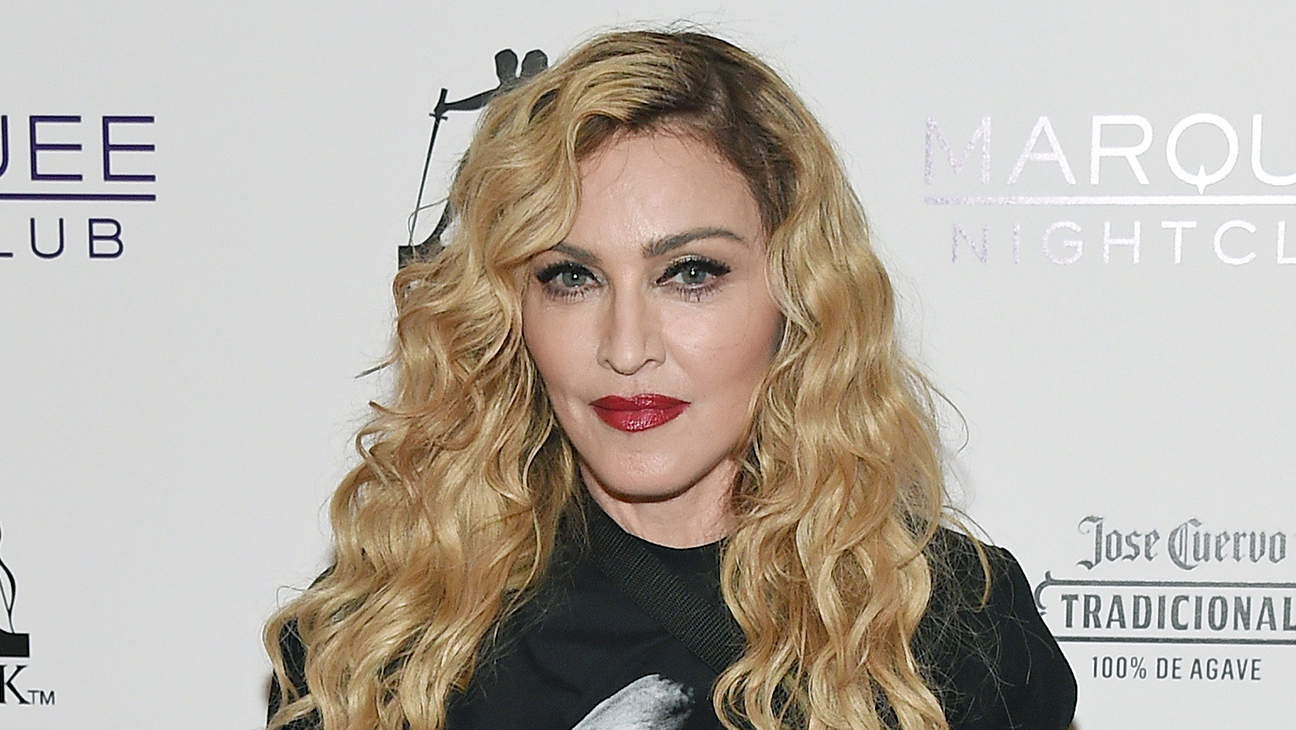
    Madonna Bored Ape NFT

    “I finally entered the MetaVerse…,………..My very own Ape! What should I name her ? … We all need protection from Evil Eye,” she wrote on Instagram, accompanied by a picture of her own Bored Ape, which was acquired through MoonPay. 

    While this is the first NFT being purchased by Madonna, she is not the first celebrity to get involved in the space. Previously, rapper Post Malone had spent roughly $700,000 on two NFTs from the collection, Bored Apes Nos. 9039 and 961. 

    Other celebrities who are known to collect NFTs include DJ Marshmello, Steve Aoki, The Chainsmokers, Lil Baby, and many more. Needless to say, NFTs have become the hottest new status symbol for the rich and famous. 

    There is also an obvious business aspect to it as celebrities are not only buying NFTs but creating them as well. For example, producer Timbaland has created his own company, Ape-In Productions, to develop and sell NFTs.

    The Power of Celebrity in NFTs 

    It is impossible to overstate the power of celebrities over the buying decisions of the public. From perfume lines to books, there is a long history of consumers buying things because it is attached to a celebrity. 

    This is why the public endorsement of NFTs by celebrities like Madonna and Timbaland is so important (Madonna has since changed her Twitter profile picture to her NFT). It signals to the public that not only are NFTs legitimate but that they are also a status symbol. 

    This is also a major win for the Bored Ape Yacht Club. Not only did its parent company, Yuga Labs, acquire two other major collections, but it recently closed out a $450 million funding round. With all this financial backing and visibility, the Ape Club has certainly had a good year so far.

  • Ukraine is Selling Its Russian War Timeline As an NFT

    Ukraine is Selling Its Russian War Timeline As an NFT

    For weeks now, the world has been gripped with the news of Russia’s invasion of Ukraine. Ever since the Ukraine-Russia war began, there has been a massive outpouring of support from the rest of the world. 

    From the #IStandWithUkraine trending on social media to several countries choosing to accept refugees from Ukraine, the global response has been resounding. 

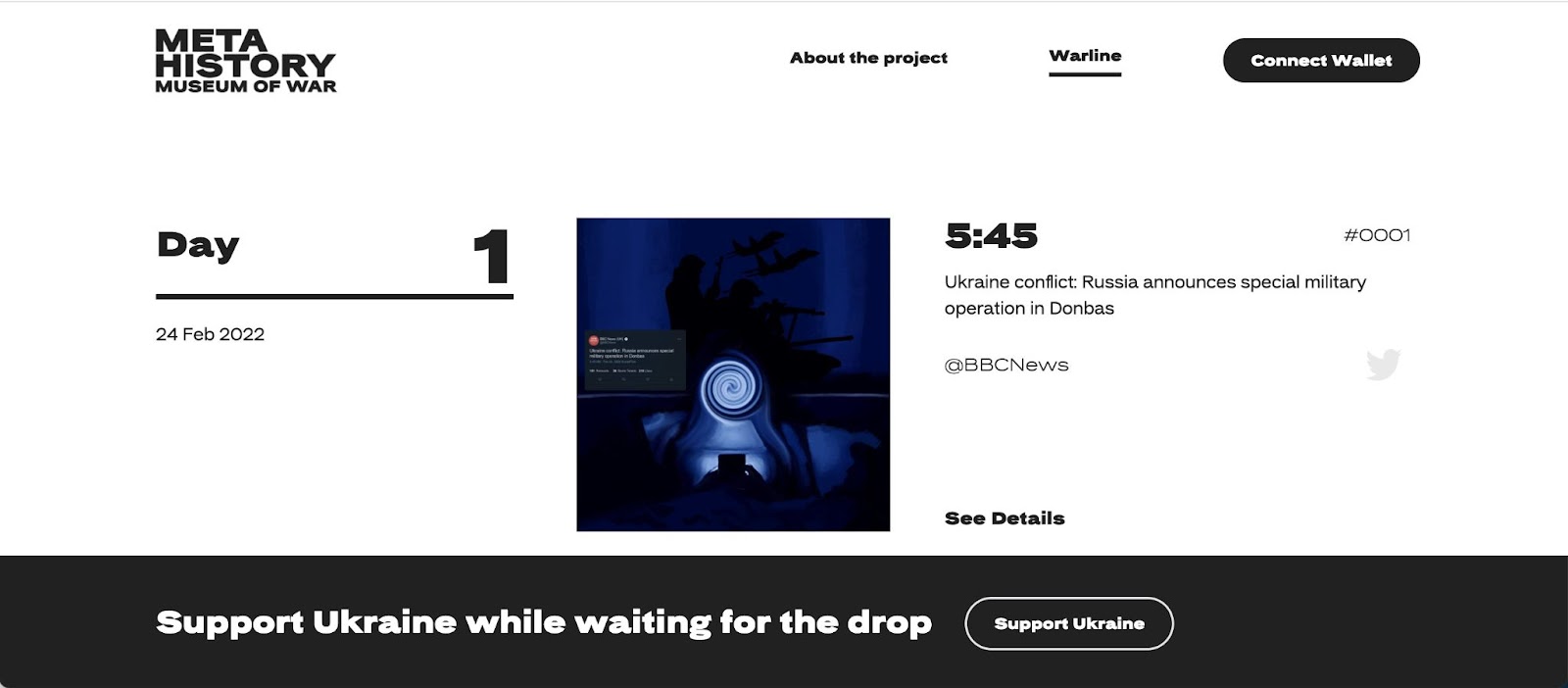
    Now, the Ukrainian government is taking an unorthodox approach to raising funds for its troops and memorializing the war; NFTs. Previously announced in early March 2022 by the Ukrainian Ministry for Digital Transformation, a digital museum of NFTs for sale has gone live

    War in the Time of NFTs?

    The collection is called the ‘Meta History Museum of War’ and currently features 54 NFTs in total. The NFTs depict the first three days of the Ukraine-Russia war in the form of illustrations done by Ukrainian and international artists as well as a tweet that was made about the situation during that time. 

    Ukraine is Selling Its Russian War Timeline- As an NFT

    The sales of these NFTs will be used to support the Ukrainian troops in their efforts. But more than this, these NFTs will be a way of documenting the war as it happens.

    As the website explains, “The formula of each NFT is clear and simple: each token is a real news piece from an official source and an illustration from artists, both Ukrainian and international. The NFTs will be created in chronological order, according to the events so the true history will be saved and cherished.”

    The documentation of war has always been very important throughout history. Entire physical museums and collections are created around the images, videos, and other content from wars around the world. 

    Now, Ukraine is getting ahead of this by creating a collection of content relating to the war as it happens rather than after the fact. 

    What Does Blockchain Mean for Wars?

    Blockchain has been a part of public life for years now and so it was inevitable that it would play some part in the Ukraine-Russia war. First, there are the donations that have been made in cryptocurrency, which has topped $100 million so far.

    In the last few years, cryptocurrency has been used as a way to raise money quickly and easily for political and humanitarian causes. However, this donation cycle might be the biggest one yet. 

    Then there is the use of blockchain for documentation. Wars have been documented in different ways over centuries but few are perhaps as permanent as a piece of digital content on a blockchain. Written records can be destroyed and even video content can be wiped but data put on a blockchain is practically eternal.

    In a sense, Ukraine is killing two birds with one stone by raising funds to support its troops while also making sure that the war is thoroughly and properly documented. As NFTs become more popular, it is likely that other world events will be documented in real-time by leveraging the power of blockchain.

  • Amitabh Bachchan Gets Hit with $130,000 Tax Bill for NFTs

    Amitabh Bachchan Gets Hit with $130,000 Tax Bill for NFTs

    NFTs are on top of the world these days. Everything from top art pieces to memes is being sold as NFTs and it has quickly become one of the most profitable niches within blockchain. Even as NFTs are fast becoming mainstream, there will be a few regulatory aspects to iron out. 

    Naturally, one of these is taxes and how they will be handled for NFTs. For example, top Indian actor Amitabh Bachchan was recently caught up in some NFT tax issues as he had been forced to pay approximately $136,000 in taxes after some of his NFTs were listed. 

    NFTs and Taxes

    This new tax bill came shortly after India’s Directorate General of Goods and Services Tax Intelligence (DGGI) opened an investigation into BeyondLife.club, a platform where his NFTs were being sold as of November 2021. 

    Amitabh Bachchan Gets Hit with $130,000 Tax Bill for NFTs

    Following the investigation, the DGGI found that he had not paid taxes on the sale of up to $1 million worth of his NFTs that had been sold. Some of the NFTs in question included his own recitation of poems from the collection Madhushala, vintage posters of his iconic films, and signed posters as well. 

    The site is a collaboration between Rhiti Entertainment, which Bachchan partnered with for the sale of his exclusive NFTs, and, GuardianLink.io. While the payment of the tax bill has reportedly been made, the Bollywood actor has not given any official statement. 

    The DGGI has also confirmed that its investigation will continue despite the payment of the tax bill. This does bring into focus the importance of the comprehensive treatment of NFTs by tax authorities. While the crypto industry waited several years before tax codes recognized them, NFTs have had an easier ride so far. 

    NFTs: The New Celebrity Status Symbol

    In the midst of all of this, it is worth considering the implications of celebrities getting involved in the NFT space. While we are used to celebrities releasing clothing lines and perfumes, many more are selling their own NFTs. 

    From Grimes to Lindsay Lohan, celebrity involvement in the NFT space can generate buzz and drive sales, as we can see in Bachchan’s case. When issues like the current tax debacle happen, it also draws a lot of attention.

    Seeing as NFTs have been accused of being money-laundering and tax evasion schemes in the past, it is refreshing to see a high-profile case of the law being followed. This is also timely given that tax codes regarding NFTs are being developed around the world, even as NFTs are defining themselves separately from cryptocurrency on the world stage.

    As more celebrities get into the NFT space and release more collections, the reporting of income and enforcement of tax codes will likely become stricter. Ultimately, this is for the benefit of the industry. Not only will it put the NFT space in good standing with regulatory bodies, but it will also endear it more to the public.

  • Phishing Attack Costs DeFinance Founder 60 NFTs

    Phishing Attack Costs DeFinance Founder 60 NFTs

    If you’ve been on the internet for long enough, you probably know some of the common scams to watch out for; fake inheritance scams, dodgy software downloads, and, of course, phishing. 

    Phishing scams are when a fraudster sends a message pretending to be a legitimate company asking you to log in to your account. You know, the often poorly-done emails claiming that your PayPal account is going to get shut down if you don’t log in now. 

    The goal of phishing scams is to collect usernames and passwords and then steal from whatever accounts the details belong to. While there is a wealth of information on how to identify and avoid these scams, even the best of us can get caught up. 

    Case in point, Arthur Cheong, the founder of DeFiance Capital, a venture capital fund with a focus on DeFi, lost over $1.7 million in NFTs from his personal wallet. This happened after he fell victim to a phishing scam. 

    Details About the Scam 

    In a now-deleted tweet from March 22, 2022, Cheong explained that not only was he a victim of a scam but that he now fears for everyday people with less digital experience. 

    “Well, this hit me hard but if I got exploited as a fairly sophisticated 5 years crypto user (DeFi user, password manager, mostly hardware wallet), I’m not sure how I can persuade most normal people to put a substantial part of their net worth on chain anymore,” the tweet said. 

    Phishing Attack Costs DeFinance Founder 60 NFTs

    It was also revealed that the NFTs had been kept in a hot wallet (a wallet connected to the internet) as opposed to a cold wallet (which is not). As for the NFTs stolen, a security company called PeckShift published an analysis of the situation. 

    As per their estimations, about 60 NFTs were stolen, all of which were from top collections. Some of the collections include CloneX, Azuki, Hedgies, and Second Self. 

    The email that caused the hack, according to Cheong, appeared to be from one of DeFinance’s portfolio companies. After a file attached to the email was clicked, Cheong’s password was compromised and the NFTs stolen. 

    This is a common feature of phishing emails, especially the more sophisticated ones. While the poorly-done ones might be spotted rather easily, some of the better ones can be so convincing that even someone like Cheong would believe that they were real. 

    Staying Safe With Crypto 

    While Cheong has since deleted his tweets and had not given any official comment on the matter, this is not a unique situation. It has been estimated that millions of dollars are lost each year to phishing schemes and unfortunately, they show no signs of stopping. 

    What can be done is to educate NFT users on how to identify phishing schemes and put as many measures in place to make sure that they don’t fall victim. If this can be done, hopefully incidents like Cheongs can be a thing of the past.

  • Abu Dhabi Eyes NFTs With New Draft Recommendations

    Abu Dhabi Eyes NFTs With New Draft Recommendations

    The trajectory of the NFT sector has been a very interesting one. A few years ago, NFTs were an idea few people had heard of. Now, billions of dollars have been poured into the market and everyone from Jack Dorsey to Grimes has released an NFT of some kind

    Needless to say, NFTs have seen quite a journey. Despite all this global visibility and success, NFTs are still a largely underregulated sector. Just like cryptocurrencies that came before them, NFTs will need some time before they are fully accepted by regulators. 

    However, it seems that Abu Dhabi might not be waiting too long to put regulatory frameworks in place for NFTs. This comes as the financial regulator of the Abu Dhabi Global Market (ADGM), a financial hub and free zone in the United Arab Emirates, has released a new consultation paper. In the paper, the hub released guidance for the legal treatment of NFTs and put out a call for more comments.

    NFT Regulations in the Middle East?

    According to the paper, which was released on March 20, 2022, the ADGM’s Financial Services Regulatory Authority (FSRA) is not looking to release formal regulations for NFTs just yet. 

    Instead, the paper, titled ​​“Proposals for enhancements to capital markets and virtual assets in ADGM” suggests that companies in the region that already have trading and custody licenses should be able to offer NFTs as well as multilateral trading facilities (MTFs) and Virtual Asset Custodians (VAC).

    This is partly because the document does not define NFTs as financial documents but rather as intellectual property. The zone’s CEO Emmanuel Givanakis also said, regarding NFTs, that  “If there’s a derivative built around them, then yes, then they become a financial instrument.”

    At the same time, some transactions involving NFTs might trigger the body’s Anti-Money Laundering (AML) and Sanctions Rules. 

    Nevertheless, there is no formal regulation for NFTs in place at this time. Instead, the paper is open to comments and contributions up until May 20, 2022. With the feedback that the paper receives, some sort of regulation might be put in place for NFTs and those who deal in them.

    Too Big to Ignore?

    While the future treatment of NFTs in Abu Dhabi and the wider UAE might not be predictable at this time, the consultation paper is indicative of the government’s attitude. More specifically, it shows that attention is being paid to NFTs and their role within the business world. 

    Crypto lovers will remember how many years it took for crypto regulation to be looked at seriously in many parts of the world. Perhaps learning from the mistakes from the past, NFT regulation seems to be on its way faster. 

    At the same time, the ADGM was one of the first regions in the world to implement comprehensive regulations for digital assets as far back as 2018. Now that NFTs are the hottest digital asset, it is only natural that they get the same treatment.

  • Bored Ape Club Raises $450 Million in $4 Billion Valuation

    Bored Ape Club Raises $450 Million in $4 Billion Valuation

    With billions in investment and new ground being broken every day, the NFT space is certainly a busy one. Few companies in the space, however, are quite as busy as Yuga Labs. Not only is Yuga Labs the home of the Bored Ape Yacht Club, one of the most valuable NFT collections in the world, but it recently acquired two new collections from Larva Labs.

    Now, Yuga Labs has another win under its belt with its recent seed funding round that saw the company raise $450 million. Now, its total post-money valuation sits at $4 billion as announced on March 22, 2022. 

    Bored Ape Club Sees Big Support 

    This latest funding round was led by venture-capital firm Andreessen Horowitz’s a16z crypto fund. It was also supported by Animoca Brands, The Sandbox, LionTree, Thrive Capital, and others. 

    According to Chris Lyons, a general partner at a16z crypto, this funding round was about not just NFTs, but the metaverse as a whole. Speaking on the round, he said, “Mainstream adoption in web3 is accelerating at lightning speed, and Yuga is at the forefront of merging culture and innovation for everyone to enter the metaverse.”

    This first seed round was also a record-breaking one, marking one of the largest-ever post-money valuations for a seed funding round. This is particularly impressive considering the company was only formed in 2021.

    With this new influx of funding and institutional support, Yuga Labs has given some insight into its next moves. According to its management, it will be expanding its team with new talent hires. 

    The company also made mention of an incoming project dubbed ‘Otherside’ that will be coming soon. 

    Growing Confidence in NFTs 

    This valuation is another achievement in a long list of wins secured by Yuga Labs in the last few months. It is also indicative of the current state of confidence in the NFT space. Despite the horde of criticism that the sector constantly receives, it is clear that the corporate world has a lot of belief in its potential. 

    There is, obviously, good reason for this level of confidence. The Bored Yacht Ape Club has grossed billions of dollars in sales so far and shows no signs of stopping. The latest acquisitions of both CryptoPunks and Meebits from Larva Labs also only work to boost Yuga Labs’ dominance in the industry. 

    As Yuga Labs CEO Nicole Muniz explained recently, its incoming projects will be looking to benefit the wider community in terms of engagement and creativity. 

    “Already, a new economy is possible with the IP of Apes, Punks, and Meebits, owned by the community. The possibilities for blockchain’s impact on culture are endless, and so we are building a beautiful, interoperable world for people to explore and play in. There’s a lot to come,” she says. 

    With all these developments so close to each other, it is clear that Yuga Labs and the Bored Ape Yacht Club won’t be going anywhere anytime soon.

  • Yuga Labs Buys CryptoPunks and Meebits, Expands NFT Empire 

    With billions of dollars in investments and global acclaim (along with some controversy), NFTs have become the hottest digital ticket of the last few years. Within the NFT space, there are a number of companies that dominate in terms of popularity and sales. One of these is Yuga Labs. 

    While non-NFT enthusiasts might not recognize the company name, they’ve probably heard of the Bored Yacht Ape Club, owned by Yuga Labs, at some point. The collection, which features images of animated apes, is one of the most popular in the world, raking in billions in sales. 

    Now, Yuga Labs is about to get even bigger as it announced on March 11, 2022, the purchase of CryptoPunks and Meebits, two top NFT collections. The collections, which have grossed several billions of dollars between them, were previously owned by Larva Labs. 

    The Ape Club Expands 

    This sale is more than just a company buying ownership of intellectual property. By owning CryptoPunks and Meebits, Yuga Labs now has control of three of the most profitable NFT collections in the world.  

    This means Yuga Labs is even more powerful within the industry and is becoming virtually unrivaled. Meanwhile, the management at Larva Labs seems to be excited about the future.

    Matt Hall and John Watkinson, the co-founders of Larva Labs, have described Yuga Labs as, “the ideal stewards of the CryptoPunks and Meebits. In their hands, we are confident that they will continue to be vital, thriving projects in the emerging decentralized web.” 

    Despite the sale, it has been reported that Larva Labs will keep the rights to some of the NFTs in the collections. 

    Making NFT History 

    NFT lovers might remember that Cryptopunks was one of the first popular NFT collections and even though many came after it, it remains popular. Currently, one of the 10,000 NFTs in the Cryptopunks collection sells for around 69.95 ETH, which is almost $200,000. 

    Meebits, on its part, tends to sell for around 4.7 ETH per NFT and is very popular on OpenSea. The two will now be joining the Bored Yacht Ape Club over at Yuga Labs. 

    Culturally, it is impossible to ignore just how influential the Ape Club has been in the industry. When many of us think of NFTs, our minds tend to go to the pixelated animal (usually monkeys or apes) profile pictures on Twitter. The Bored Yacht Ape Club was one of the first collections of that type to explode in popularity. 

    In many ways, the Ape Club set the public standard for what we think of as NFTs. Now, its parent company is well on its way to becoming a bigger force in the NFT space not just culturally but financially as well. 

    As the space is on track to grow even bigger in the next few years, it will be interesting to see what other studios might compete with Yuga Labs for control over top projects. Till then, we’ll just have to watch the market unfold, one NFT at a time.

  • NFT Owner Sells Million Dollar NFT for a Penny After Error

    The good thing about transactions that take place across blockchains is that they are permanent once completed and cannot be undone. 

    The bad thing about transactions that  take place across blockchains is also that they are permanent once completed and cannot be undone. This is why blockchain users are always advised to double-check every transaction before they complete it. 

    As every crypto exchange will tell you, if you send funds to the wrong address or the wrong blockchain, not much can be done after the fact.   

    One unlucky NFT merchant learned this the hard way after a rock NFT that was valued at over $1.2 million was sold for less than a penny after they made a mistake with the listing details. 

    Rocky Roads for an NFT Merchant 

    The merchant, who goes by @dino_dealer on Twitter, revealed on March 10, 2022, that while trying to list their NFT for 444 ETH (worth roughly $1.2 million), they accidentally listed it for 44 Wei (worth less than a penny). The NFT, which was a picture of a rock, was almost immediately bought by a bot sniper for the very low amount. 

    Because of how popular NFTs have become, many people these days use bots to buy them as cheaply as they can. Similar to ticket scalpers, the goal is usually to resell the NFTs for as much as possible to others. 

    The unfortunate incident is probably the worst-case scenario for an NFT seller. Once an NFT is sold, the transaction can’t be reversed and considering the fact that the bot is already trying to sell it for several thousand times what it cost, there isn’t a likely resolution between the two. 

    The story quickly went viral on social media and served as a cautionary tale for potential NFT sellers and for blockchain users as a whole. We’ve seen several times where the mistake of a single person can lead to incalculable losses for others.

    Who can forget the incident of the CEO of QuadrigaCX, Gerry Cotten, who died with the private keys to the company’s cold wallet, leaving hundreds of millions of dollars lost forever? 

    Moving On?

    While this made for a funny, albeit cringe-inducing Twitter moment, it does bring up the question of whether or not the industry needs a change.

    Is the lack of centralized support for when things like this happen something that should be looked into? Is it just the price we pay for using blockchain?

    The merchant, however, seems to be moving past the whole incident. Shortly after, they changed their profile picture to one of Pepe the frog dressed as a clown with sad rocks in the background.