Category: Marketplaces

  • Binance NFT

    Binance NFT

    Binance NFT Review

    Binance NFT is an innovative marketplace created and controlled by Binance. The platform is intuitive and easy to use. The result of its integration with the broader Binance ecosystem is that it provides its users with access to benefits that other NFT marketplaces cannot replicate.
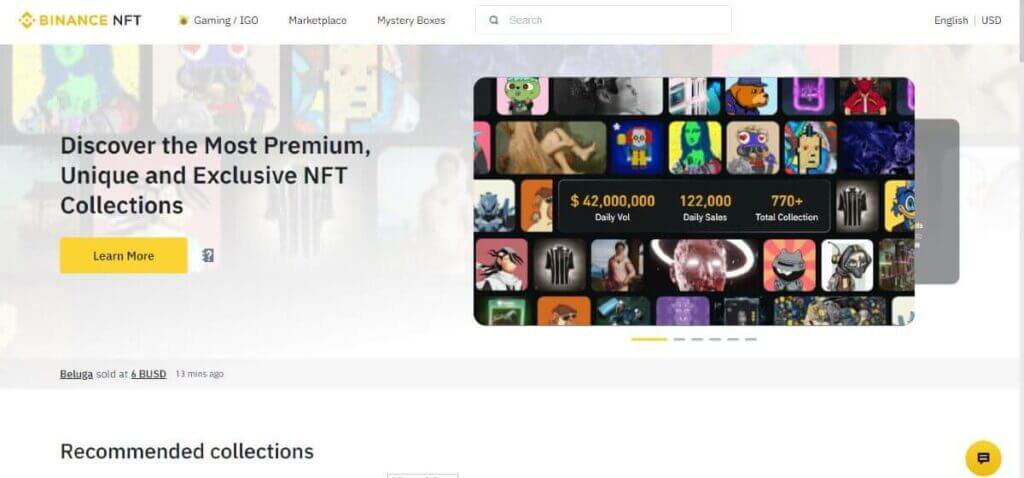
    binance nft overview

    Although Binance currently restricts minting on the platform to pre-approved artists, extensive NFT collections are available for trading, and the marketplace is buzzing with activity.

    Through its Marketplace, Binance enables users to buy, bid on, and sell NFTs from creators worldwide while protecting creators by allowing them to have royalties from future sales of their works. 

    With Mystery Box, Binance offers users the opportunity to win a variety of NFTs, some of which may end up being assets of immense value if they have unique characteristics and high rarity levels.

    With its innovative Initial Game Offering feature, Binance offers game developers an avenue to connect with players and derive unique income streams for their franchises. At the same time, it creates a means by which gaming enthusiasts can collect one-of-a-kind gaming assets that cannot be found on any other platform.

    The restrictions on minting serve as a stumbling block, but Binance has been able to work around these to build an NFT marketplace buzzing with activity. By integrating the Binance NFT marketplace with the broader Binance ecosystem, Binance has unlocked a new channel through which it can continue to bring fresh users to its platform. These features, and more, give it a competitive advantage that few of its competitors can replicate.

    What is Binance NFT?

    Binance NFT is an NFT trading marketplace created by Binance. The project was launched in mid-2021 and warmly welcomed the NFT community. Although Binance NFT restricts minting services to a select few creators, all users are welcome to buy and sell NFTs on the platform as they would on any other platform.

    Binance NFT’s number one competitive advantage is integrating into the market saturation its parent company enjoys. This makes it easy for Binance cryptocurrency traders to easily test out the NFT side of the operation if they’ve never experienced NFTs or move their NFT trading activities to the platform to leverage Binance’s security features and its large number of users.

    How does Binance NFT work?

    The Binance NFT marketplace has a futuristic look and focuses on handpicked NFTs from the visual arts, sports, music, and gaming verticals.

    In terms of architecture, Binance NFT uses a dual-chain system, incorporating both the Binance Smart Chain (BSC) and the Ethereum Network into its infrastructure. This dual chain architecture allows users to access Ethereum-based NFTs in their Binance wallets, even though it is designed to run primarily on the Binance Smart Chain (BSC) due to its lower gas fees than the Ethereum Network.

    The Binance NFT marketplace will use the same account structure as Binance.com, allowing users to interact with the NFT platform and the rest of the Binance ecosystem’s services. Binance NFT’s architecture is designed to support its aim of completely transforming the NFT business and becoming a leader in the field.

    What features does Binance NFT have?

    Marketplace
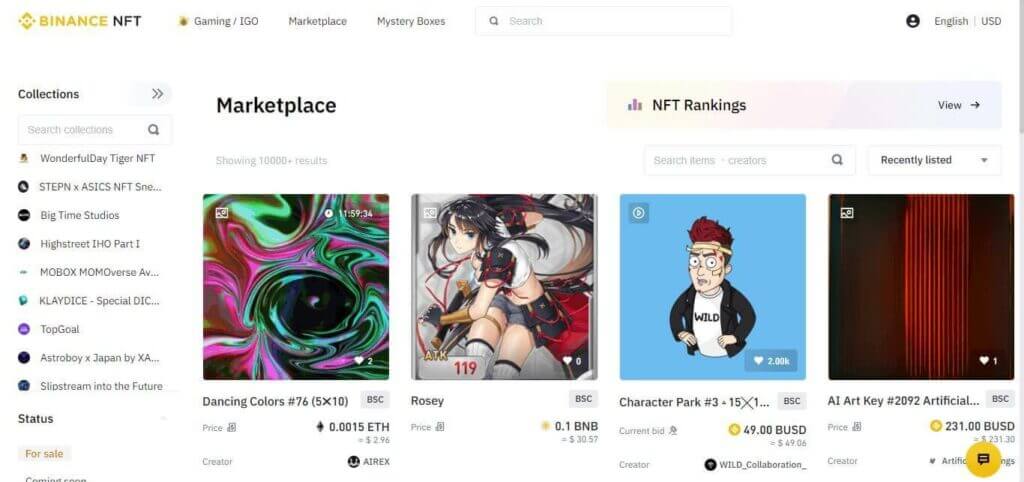
    binance nft marketplace

    The Marketplace forms the core of the Binance NFT platform. It is the most used feature on the Binance NFT marketplace because it displays all of the NFTs available for sale.

    The marketplace features the following categories of NFTs:

    • Premium
    • Art
    • Sports
    • Entertainment
    • Gaming
    • Collectibles
    • Esports
    • NFT for Good

    Mystery Boxes

    A Mystery Box contains a mix of NFT assets with varying characteristics and rarity. The user can choose to flip the Mystery Box by selling it to another user before opening it, or the user can unlock the box to reveal the NFTs inside it.

    Initial Game Offering (IGOs)

    Initial Game Offerings, or IGOs, are Binance NFT assets from top-tier gaming projects only available on Binance NFT. An auction, fixed price sale, or mystery boxes are options for game developers to launch assets.

    All drop content will include in-game assets such as early-access passes, weapons and gear, exclusive Binance aesthetics, skins, and so on.

    What wallets does Binance NFT support?

    Binance NFT uses the internal Binance Funding and Spot wallets for trading. 

    • Funding wallet: The Funding Wallet balance reflects a user’s total crypto balance from P2P buy/sell orders, Binance Payment, Binance Card and Crypto Deposit/Withdrawal.
    • Spot wallet: Spot wallet is a non-custodial wallet where the user’s funds are stored on the Binance platform before they trade.

    Binance NFT operates differently than most other NFT exchanges in that it isn’t a standalone site that allows third-party wallets to be plugged in. You can store your Binance NFT assets in a third party wallet but you will need to create a Binance account and send the assets to that account address in order to trade them.

    Since both the Funding and Spot wallets are owned and controlled by Binance there is nothing you need to do except make sure you have funds in there. To add funds log in to your Binance account, go to your account, select ‘Transfer’ from the boxes at the top of the screen. There you can switch funds between your ‘Fiate and Spot’ and ‘Funding’ wallets as necessary. You can also deposit crypto from an external source or even buy it with a bank card through Binance.

    You may not be able to hook up a wallet to trade on Binance NFT but you can still withdraw NFTs to supported wallets, such as MetaMask and Trust Wallet. This can be done through the ‘withdraw’ option in your Binance NFT account.

    How do I buy NFTs at Binance NFT?

    Buying NFTs off Binance is very straightforward. You can acquire assets in one of two ways:

    Auctions
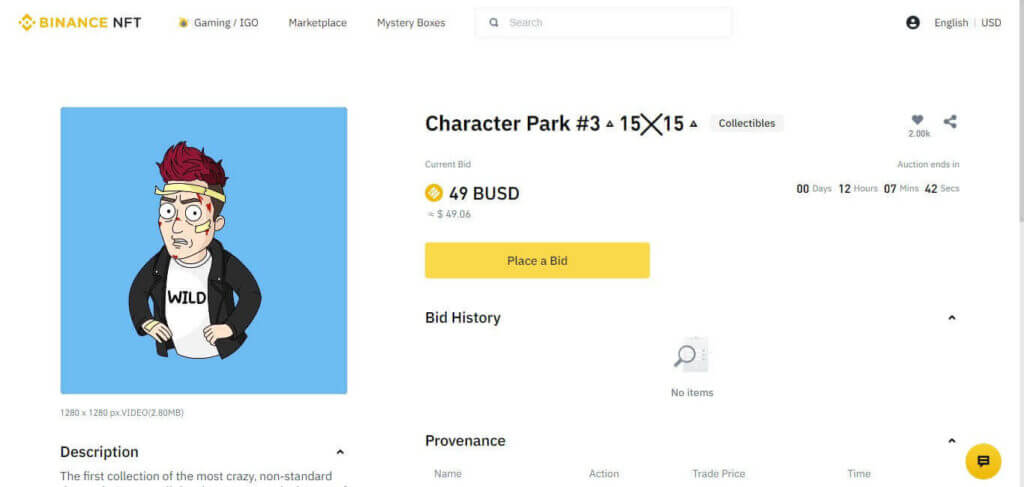
    binance nft auction

    NFTs with this purchase feature allow you to bid on them in competition with other interested buyers.

    The process is similar to typical auctions on other NFT marketplaces or platforms like Ebay. When the auction ends, the person with the highest bid will walk away with the NFT in their wallet.

    • Log in to Binance NFT.
    • Open the Marketplace tab.
    • Find an interesting NFT and click on it to load up the purchase page.
    • Click on “Place a Bid”.
    • A pop-up window will appear, requiring the user to input the amount they would like to bid. Since the Binance NFT marketplace supports three different cryptocurrencies, the particular currency that the user will place the bid with may vary, so it is advisable to pay attention to what currency the seller is asking for.
    • Input bid amount. A minimum bid markup will be added to the amount.
    • Click “Place a Bid” to complete the process.
    • Monitor the auction and make new bids if necessary.

    Once a bid is placed, Binance NFT locks the corresponding amount in the user’s wallet while the auction is ongoing. If a user places a bid higher than the bid, the locked bid is unlocked or may remain locked until the auction ends. 

    Fixed-price NFTs 

    This process is straightforward and uncompetitive. 

    • Log in to Binance NFT
    • Open the Marketplace tab
    • Find an interesting NFT and click on it to open the purchase page
    • Click on “Buy Now” and pay the total price
    • Once the purchase is completed, the NFT will appear on your Binance NFT inventory page. 

    The same processes apply to purchasing Mystery Boxes. The user can choose to buy the Mystery box instantly or Make a Bid for it. Each Mystery Box contains a variety of NFTs with different features and rarity.

    How do I sell NFTs at Binance NFT?

    Selling NFTs on Binance NFT is just as easy as buying them. To sell on Binance NFT, all a user needs to do is follow these steps:

    • Log in to Binance NFT
    • Click on the Profile icon
    • Click on “User Center”
    • Click NFT Asset or Mystery Box to select an NFT you own
    • On the page, hover over the NFT asset to be sold with the cursor
    • Click on “List Asset”
    • The NF’s description page will load. The user will find a bold yellow button labelled “List NFT”
    • Click on “List NFT”
    • The user will be asked to select a sell method. There are two options:
      • Set price: The user will be asked to input the price, select the crypto they would like to be paid with, and the expiration date for the listing.
      • Highest Bid: The user will be asked to choose their preferred crypto, enter a minimum bid amount, and can also enter a buy-out price if they have a preferred selling price.
    • Click submit
    • Choose to either list immediately after review or at a custom list time
    • Click “Submit”

    If the Binance NFT review time does not complete the listing review before the custom list time, the NFT will be listed immediately after approval. 

    How do I mint NFTs at Binance NFT?

    Binance currently only allows pre-approved creators to mint NFTs using the platform, but it says that it promises to “open up the feature to other users in the future”.

    If you have been lucky enough to be a pre-approved Binance NFT minter, follow these steps:

    • Log in to Binance NFT
    • Ensure you have enough BNB to over the minting fee
    • Click “Create” in the top-right corner of the home screen
    • The “Create an NFT” page will load up
    • Add all necessary information to mint the NFT:
      • Preview
      • Collection Type:
        • Single NFT (BEP-721)
        • Series: (BEP-1155: with this format, the user can sell multiple versions of the collectible item while retaining a unique identifier for each one)
      • Name
      • Description
      • Fee
    • Click “Create”

    Once the ‘create’ button has been clicked, Binance will create the NFT, and it will be available on the “Collections” page under NFT Asset.

    Conclusion

    With its dual chain architecture and user base, Binance NFT is well placed in its aims to bring additional liquidity to the world of non-fungible tokens and expand the reach of both famous and unknown creators by leveraging network effects and its reputation.

    Since Binance NFT uses the same network as the Binance exchange, users can access the Binance NFT marketplace directly from their Binance wallet without signing up again. This is great for those who already have an account, but those who haven’t signed up for one by this point are unlikely to do so now because of Binance NFT.

    With standout features like the Initial Game Offering and a curated selection of NFT collections, Binance seeks to entrench itself firmly in the NFT industry and accrue more social capital to the Binance brand.

    However, despite all these positives, we can’t overlook the fact that this is an entirely centralized operation that requires users to pass AML/KYC and hold their NFTs on the exchange. This will be a bridge too far for many serious NFT collectors, meaning that Binance NFT may find that it only reaches a certain level of market penetration.
  • X2Y2

    X2Y2

    Complete review of the NFT Marketplace X2Y2

    X2Y2 is one of the newest NFT marketplaces for NFT trading. It launched in February of 2022, and has taken the fight to OpenSea in a bid to decentralize the NFT market and bring useful features such as bulk buying and selling to its users.

    X2Y2 has its own governance token of the same name that brings benefits such as profit sharing from market fees and this heavily incentivizes NFT trading on the platform. 

    So, without further ado, let us dive deeper into this young NFT marketplace and see how it holds up to titans like OpenSea.

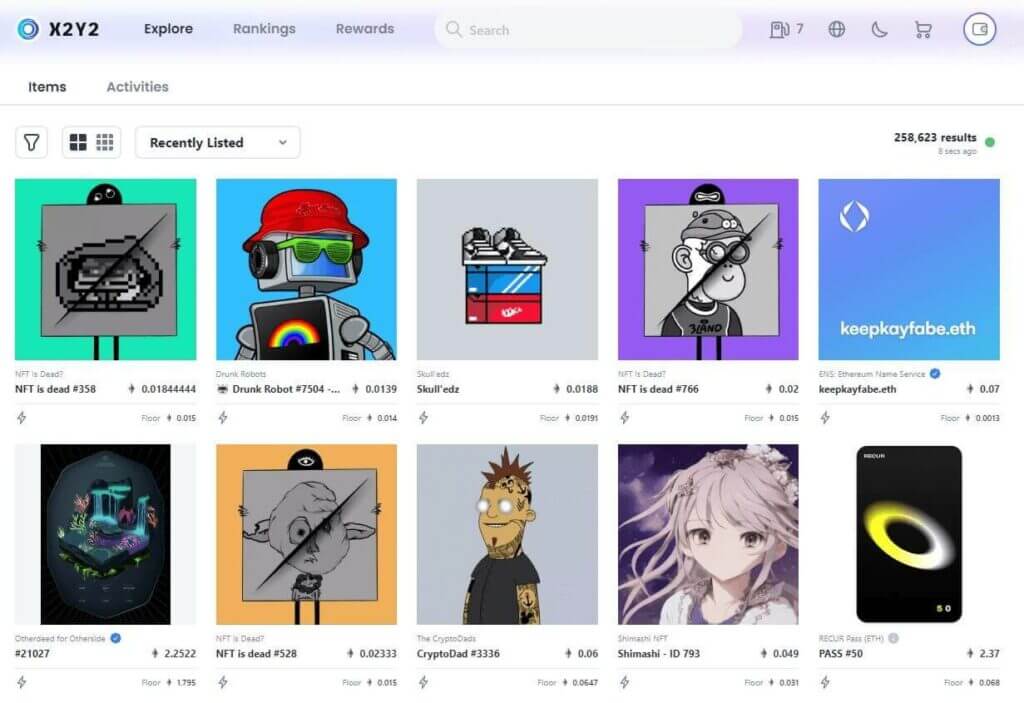
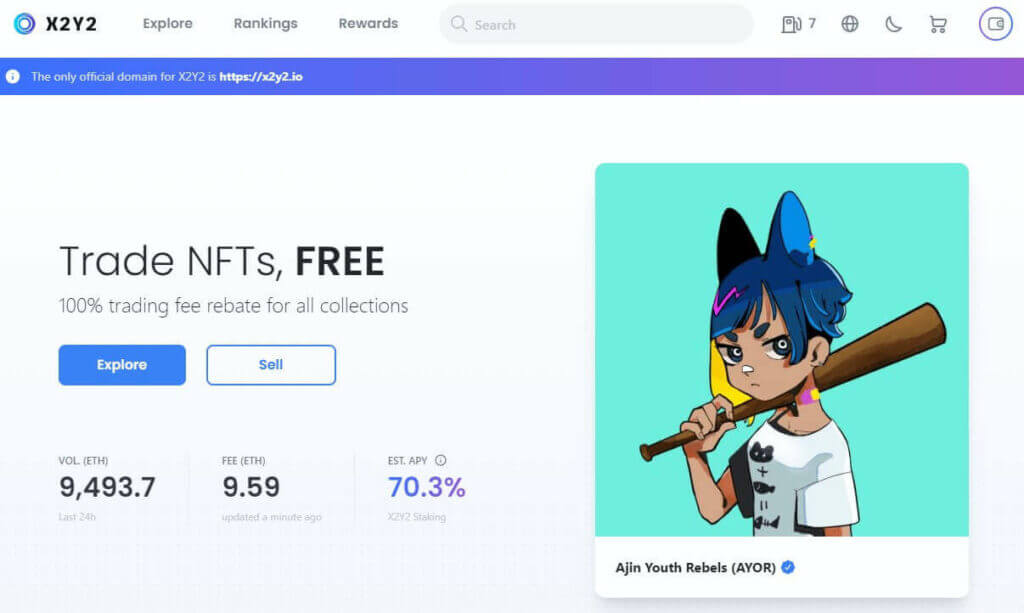
    this is the x2y2 homepage

    What is the X2Y2 NFT marketplace?

    X2Y2 is an NFT marketplace that decided to shake things up a little in the world of NFT trading. It has a wide variety of useful and new features that sets them apart from the competition. 

    One of the main features is also the main benefit of using the marketplace: profit sharing. X2Y2 is in fact one of the first NFT marketplace to offer this. Users can stake X2Y2 tokens on the platform, and depending on how many tokens they stake they will receive a percentage of all fees from NFT trading on the platform. Loyalty really pays off here. 

    Are you tired of paying fortunes in gas fees for your NFT trades? Just about anyone is. But here X2Y2 offers a simple yet effective solution: bulk buying and selling. This means you can sell and buy as many NFTs as you want at the same time, only paying the gas fee once!

    X2Y2 also makes it easy for you to keep track of what’s going on with your listed NFTs. As soon as there is a bid or a direct sale on a user’s NFT, they will receive an email notifying them of this. And if they themselves bid on something, they will also get an email notification if the bid is accepted.

    If you’re hunting for rare items, X2Y2 gives you the edge. X2Y2 features a very intuitive rarity tracker. This tracks the rarity for any NFT and it also shows detailed analytics and history of any NFT. 

    Which NFTs are on the X2Y2 marketplace?

    The X2Y2 marketplace is only compatible with Ethereum mainnet NFTs. That means you will not be able to sell or buy NFTs from any other blockchains on the site. 

    In terms of available collections on X2Y2, you can find many similar collections to OpenSea such as Bored Ape Yacht Club, Azuki, and Akutars among many others. 

    You can also check out the “Hot collections” tab to see which collections are trending right now in terms of most-traded collections and other useful analytics. 

    This is a great way to keep track of how the NFT marketplace is developing, and for you to find interesting NFT projects to get in on while they trend. 

    At the time of writing this review, 125,894 unique items are listed on the X2Y2 marketplace, which is a pretty decent amount of NFTs. It doesn’t come close to the levels OpenSea has available, but it is clear that X2Y2 is making a dent in the market.

    explore the x2y2 marketplace

    The X2Y2 token – How to get it and what to use it for

    As mentioned earlier, X2Y2 has its own governance token of the same name. In more technical terms, it is an ERC-20 coin hosted on the Ethereum network. It launched along with the X2Y2 marketplace in February of 2022. 

    It was quite the big news in the NFT community at the time due its airdrops. In total, there are 1,000,000,000 (1B) X2Y2 tokens in existence. However, not all of them are in circulation yet. The fully diluted market cap will be $340 million when the circulation process is complete. 

    12% of the full X2Y2 token supply was airdropped to users who had listed an NFT on OpenSea. The trade volume did not matter in this instance which made it essentially accessible for everyone. 

    If you are eligible thanks to the reason above, you can connect your wallet to the X2Y2 website and claim your free X2Y2 tokens. 

    Once you have the tokens, you can decide to sell them for a nice little profit. But the smarter thing would be to stake them. This allows you to be a part of the X2Y2 marketplace’s great profit sharing.

    If you have X2Y2 staked, you will be able to earn a % relative to the staked amount of any trading fees for any NFT on the website. 

    X2Y2 tokens – Its price and the future

    Seeing as the X2Y2 tokens are an essential part of the marketplace as a whole, it is a good idea to take a look at its price history and performance so far. 

    The price of X2Y2 peaked in February shortly after the release of the marketplace and the token. The price per token was at this time $3.7. The rapid increase in value is most likely due to the many OpenSea users who claimed their share of the X2Y2 tokens and sold them off immediately. 

    Now, the price is significantly lower, but it has remained very stable for months. At the time of writing this article, the price is $0.1. Looking at the price history so far, there is no reason to believe that the price will experience any significant changes in the near future unless something big happens. 

    X2Y2 tokenonomics 2.0

    We’ve touched a good deal on the X2Y2 token so far, but soon they will be making changes to how these tokens will be distributed. 

    Previously, the tokens were airdropped to users who had made listings irregardless of whether they were sold or not. X2Y2 felt that this was not optimal as it encouraged the listing of items with a low chance of being sold. 

    Now, they will be moving to a scheme of trading rewards in a bid to encourage NFT traders to buy and sell quality NFTs and to reward their platform users for their loyalty. 

    Going forward, 624,902 X2Y2 tokens will be distributed daily to NFT buyers and sellers on the platform. 

    For current and future X2Y2 holders and stakers, this will prove to be a bonus. As the new trading rewards scheme incentivizes buying and selling, the platform is predicted to become more active. With more trades happening, you will earn more from your staked X2Y2.

    How does X2Y2 hold up against OpenSea?

    There is no doubt about OpenSea being the biggest player on the NFT marketplace. But that doesn’t necessarily mean it is the best in every situation. This begs the question of how good X2Y2 is compared to OpenSea. 

    First of all we can touch on the visuals. Both platforms are very similar in appearance, so there should not be any problems navigating X2Y2’s interface if you’re used to OpenSea. X2Y2 is also very intuitive from a first glance, giving you just three simple tabs to browse: Explore, Rankings, and Rewards. 

    However, the real kicker lies in the features of the X2Y2 marketplace and the effect they have on the NFT community as a whole. 

    As mentioned earlier, X2Y2 has bulk selling. OpenSea does not. This means, in effect, that it can be much cheaper to trade on X2Y2 as you can bulk buy every NFT you are interested in and only pay the gas fee once. 

    OpenSea charges a fee for every transaction made on the platform. They then simply pocket the profits. X2Y2 shares the profits of all fees with the community, giving value back to the users through the use of the X2Y2 token. OpenSea doesn’t have their own governance token, which is also one of the big differences. 

    And then there is X2Y2’s position as a competitor to OpenSea. With most of NFT collections being sold on OpenSea, this has led to a heavy centralization of the market which is in direct opposition to what NFTs really are all about: decentralization.

    X2Y2 wants to change that and decentralize the market. And with the useful features the X2Y2 marketplace comes with they might just be able to do so.

    Closing thoughts

    X2Y2 is an NFT marketplace with a user-friendly and intuitive interface and many useful features. One of the biggest of these features is the profit sharing that exists on their platform through their X2Y2 ERC-20 token. Going forward, the token will incentivize the buying and selling on the platform – breathing reinvigorated life into the marketplace.

    While the X2Y2 marketplace is limited to NFTs exclusively from the Ethereum blockchain, there is still a large and significant amount of available items to purchase. Maybe they will expand to other blockchains in the future. Only time can tell. 

    Compared to giants like OpenSea, X2Y2 holds its own very well. A lot of the success lies in their alternative way of facilitating NFT trading on their platform. Now, the user is in the forefront, and they are rewarded for engaging with the NFT community and that’s what it’s all about in the end.

  • Looksrare

    Looksrare

    Looksrare NFT Summary

    Looksrare NFT marketplace has a different ethos to many other NFT exchanges, with its community-first approach winning a loyal band of followers. It is built just as well as more reputable (and better funded) NFT exchanges, while its completely decentralized structure is ideal for those who want to trade in private.

    Looksrare is powered by Looksrare’s $LOOKS token, which is the primary way in which users are rewarded, with tokens awarded to those who buy and sell on the platform. Looksrare also offers a staking mechanism through which users can earn up to 75% APY.  However, the token is subject to the wild whims of the greater crypto market, and abuse of this reward system is known to have taken place, and potentially still be occurring.

    looksrare nft

    Looksrare NFT Review

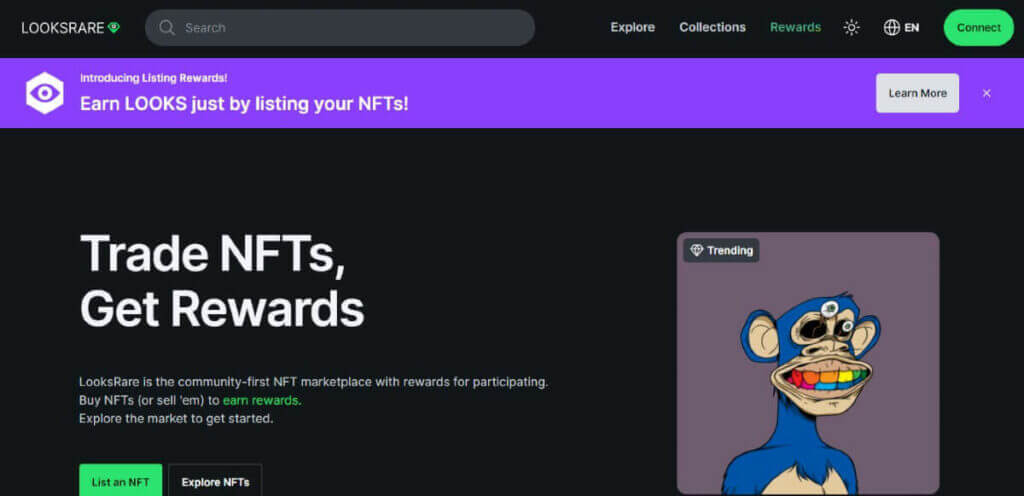
    Looksrare positions itself as a community-first NFT marketplace. To reinforce this, Looksrare operates a decentralized platform and distributes 100% of revenues from activities on the platform among $LOOKS stakers.

    The rewards-based business model has enabled Looksrare to attract almost 80,000 traders since it launched, executing over $23 billion worth of transactions (although it is unknown how much of this was genuine and how much was wash trading).

    Looksrare has become a favorite NFT exchange for those who want an alternative to the big players such as OpenSea, Binance NFT, and Rarible. However, it has attracted criticism for the lack of a mobile app, the lack of an NFT minting process, and the fact that the all-important $LOOKS token is subject to wild volatility, which reduces the incentive to stake.

    What is Looksrare?

    Looksrare NFT marketplace is an NFT exchange that facilitates the buying and selling of NFTs on the Ethereum blockchain, rewarding users of its platform with its $LOOK token – users earn trading rewards whenever they buy or sell NFTs on Looksrare, collect points for listing NFTs from selected eligible collections, and take a share of the revenues Looksrare shares with stakers.

    Looksrare distributes the rewards once a day, with users able to hold, sell instantly on a number of cryptocurrency exchanges, or stake for up to 75% APY.

    By taking a community-first approach, Looksrare distinguishes itself from the competition, which takes the shape of primarily centralized platforms owned and controlled by a corporation, and it has carved out a niche as the most popular decentralized NFT marketplace out there.

    How does Looksrare work?

    Looksrare NFT marketplace is built on Ethereum, so it operates with a single-chain architecture. Looksrare has indexed every NFT on the Ethereum blockchain, which means that users of Looksrare can purchase any Ethereum-based NFT directly from the site, including those on more popular platforms like OpenSea.

    $LOOKS rewards are based on 24-hour trade volume, with higher trading days resulting in higher rewards for users. Its staking program allows users to compound their gains, although with the value of $LOOKS tokens being decided by the market, this may not turn out to be a financially sound idea – the $LOOKS token dropped from highs of $6 in January 2022 to just $0.50 just five months later.

    Transactions on the Looksrare platform are executed through various digital wallets using two currencies, ETH and wETH (Wrapped ETH) tokens, or a combination of the two. Initially, only purchases with $LOOKS tokens were possible, but this policy has been scrapped. All NFTs purchased on Looksrare can be listed on secondary marketplaces. 

    What features does Looksrare have?

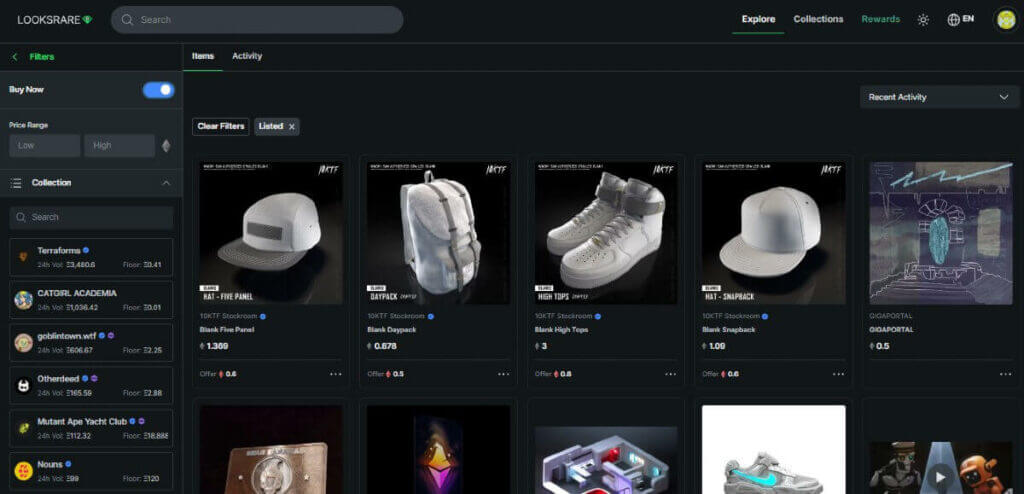
    Explore

    looksrare features

    The explore page is divided into two sections:

    • Items: a list of all NFTs available for purchase
    • Activity: real-time updates on trading activities on the platform

    Looksrare’s Explore page features a variety of tools to aid the user’s search. They are:

    • Buy Now: displays NFTs with only the “Buy Now” purchase method.
    • Price Range: isplays NFTs within a preferred price range.
    • Collection: the user can search for a particular NFT collection with the search bar. A list of the most prominent NFT collections on the platform is displayed beneath the search bar.

    Collections

    The collections page features a ranking of all NFTs on Looksrare, ranked by floor price, volume, and other metrics. The collections page allows users to filter the rankings to display all the collections or just the verified ones.

    Rewards

    The rewards page serves as a portal through which users can compound or stake their $LOOKS token. It is divided into two segments:

    • Staking: this segment houses the following rewards mechanisms – 
      • Looks Compounder: users can use this earning mechanism to auto-compound WETH rewards into more $LOOKS.
      • Looks Staking: users can stake their $LOOKS and WETH for a percentage return (currently 56% APY).
    • Listing & Trading: the Listing & Trading page contains information on the following earned rewards – 
      • Trading Rewards: how much trading rewards the user has earned from buying and selling NFTs on Looksrare
      • Listing Rewards: how many points the user has earned by listing NFTs from eligible collections.

    What wallets does Looksrare support?

    Looksrare supports three wallets at present:

    • MetaMask Wallet
    • WalletConnect Wallet
    • Coinbase Wallet

    While there is no publicized desire to expand this wallet selection, decentralized platforms often do end up offering more wallet choices than centralized entities, so we may see more options become available over time

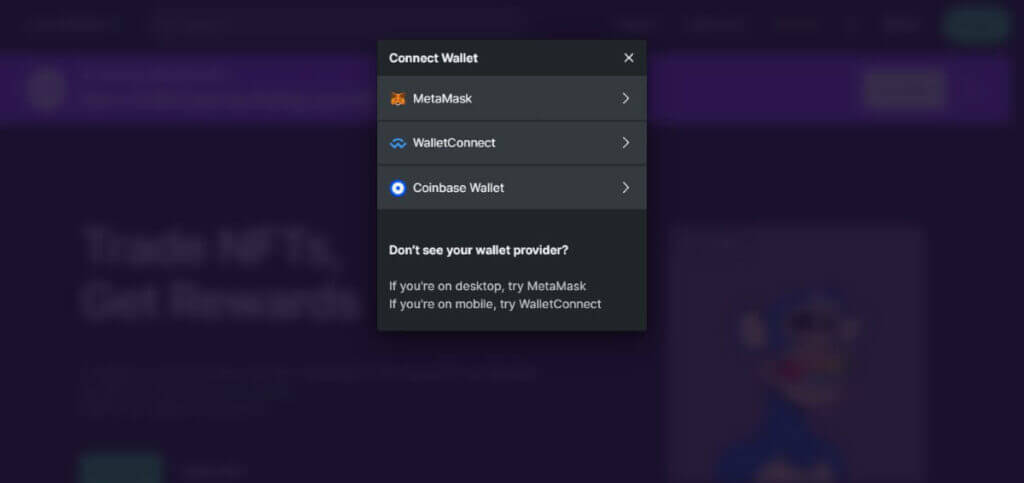
    link your wallet to looksrare
    • Open up the Looksrare website in a browser
    • In the top-right corner, click “Connect”
    • A pop-up menu will appear with the three wallets Looksrare supports. Select a wallet and authenticate the connection to Looksrare
    • The wallet is now linked to Looksrare, and a profile is automatically created

    All wallets will deal with authentication slightly differently, but all will have a pop-up prompting a sign in, so just follow those instructions. It is important to ensure that the Looksrare site being signed into is the real one.

    How do I buy NFTs at Looksrare?

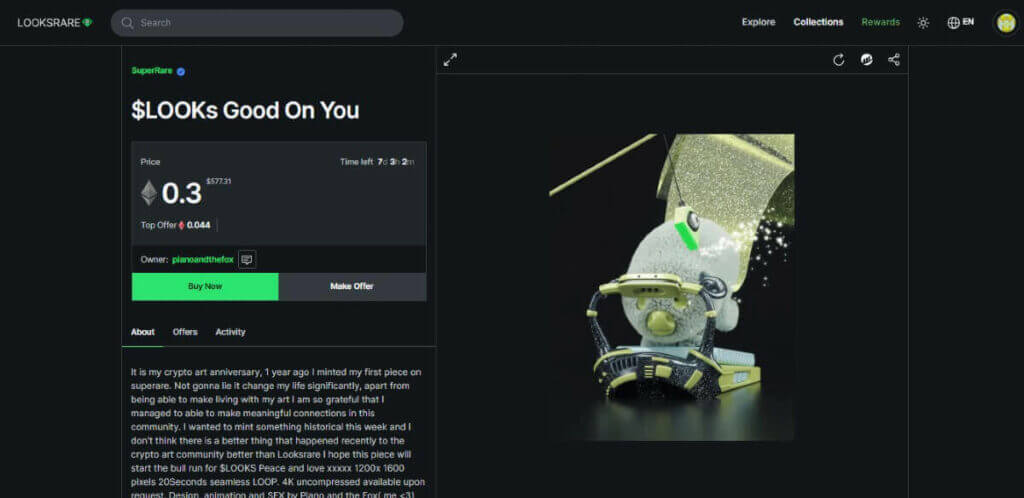
    how to buy nfts on looksrare

    Once an NFT has been spotted, follow these steps to purchase it:

    • Click on the NFT.
    • Looksrare allows you to “Buy Now” or “Make Offer”, or a mix of both. 
    • To make an instant purchase with the “Buy Now” option:
      • Click on the “Buy Now” button.
      • A checkout popup will appear with the cost of the NFT. Choose to pay with WETH or ETH.
      • Click “Buy Now” and follow the prompts to authenticate and complete the transaction.
    • To buy the NFT with the “Make Offer” option:
      • Click on the “Make Offer” button.
      • A pop-up will appear with the cost of the NFT. Users can only make offers in WETH.
      • Input your offer in the “Input price” bar.
      • Click “Make Offer” and follow the prompts to authenticate and complete the transaction. Wait for acceptance or rejection.

    How do I sell NFTs at Looksrare?

    Selling NFTs on Looksrare is just as easy as buying:

    • Click on the profile icon in the top-right corner.
    • In the slide-in menu, click on “My Items”.
    • Find the NFT to be sold and click on it. On the NFT’s page, click on “Sell” in the top-right corner.
    • A pop-up menu will appear. The user can either sell the NFT at a fixed price or an auction. 
    • Input the desired sale price. 
    • Schedule the sale or sell to a specific buyer if desired.
    • For first time sellers, the site will ask the user to approve the collection for trading. Click “Approve”.
    • Follow the prompts to authenticate the transaction and complete the listing.

    Conclusion

    Although it is relatively new to the NFT scene, Looksrare takes a unique approach to how an NFT marketplace can be structured and how users can get rewarded for participating in platform activities. Looksrare is cheap and easy to use, and it provides users with an extra source of income by allowing them to stake their tokens to earn passive income, albeit at the whims of the crypto market.

    Looksrare has indexed all the NFTs available on the Ethereum blockchain, so users will not lack options if they choose to use the platform. However, with the competition adding NFTs from other blockchains, Looksrare could suffer if it doesn’t follow suit, or at least do something original.

    Looksrare has its core of fans, and indeed in its early days it even overtook the trading volume of market leader OpenSea. However, it was revealed that much of this was down to wash trading to accumulate $LOOKS tokens and dump them at the peak, which has harmed Looksrare’s reputation – indeed, accusations of wash trading for this purpose still afflict the exchange.

    Looksrare is the most popular decentralized NFT marketplace, but unless it can find a solution to its wash trading problem, and potentially look at expanding the blockchains it supports, it may find its crown slipping in the not too distant future.

  • Coinbase NFT

    Coinbase NFT

    Coinbase NFT Summary

    Coinbase NFT is an NFT marketplace from Coinbase, America’s largest cryptocurrency exchange and one of the best known in the world. Coinbase NFT’s stated goals for the platform are to “provide the best user experience” for NFT collectors and traders and to increase “social engagement” around the asset class.

    Coinbase NFT launched in beta in April 2022 to a select number of users on a waitlist. When it did open it offered a curated selection of NFT collections, including Doodles, World of Women, and Azuki.

    Coinbase NFT received just 3,422 users within its first 20 days. This is just 10% of the traffic that leading NFT marketplace OpenSea gets per day, but there were several mitigating factors affecting this, including a massive downturn in the NFT ecosystem at the time.

    With 98 million registered users of its cryptocurrency platform and a big reputation in the space, it remains to be seen if Coinbase NFT will replicate the success of its mightily successful cousin.

    Coinbase NFT Review

    Coinbase NFT is a departure from the structure that typifies NFT marketplaces. Coinbase took inspiration from Instagram and other social media platforms to design Coinbase NFT’s user interface, imbuing it with a strong resemblance to a social media platform. 

    With Coinbase NFT, users can discover new NFTs and creators through the “Discover” tab, whose structure is similar to an Instagram feed; users can browse through comments as well as NFTs to find out what others think of an NFT, encouraging discussion of collections and individual pieces. 

    The social features of Coinbase’s NFT marketplace could be of immense benefit to new and upcoming creators if its algorithm functions in a manner similar to those of Instagram and, most significantly, TikTok. Unlike massive NFT marketplaces like OpenSea, where a new creator’s NFTs could get lost in the deluge of new NFTs being minted daily, the “Discover” tab could broadcast the NFTs of new creators and help them reach collectors and amass a following.

    If implemented well, the Coinbase NFT algorithm could be a gamechanger that truly democratizes wealth creation for artists. Coinbase NFT currently limits users’ ability to mint NFTs, but it plans to announce such a facility “soon”. There are many NFT collections on the platform with thousands per collection, so users have a lot of exploring opportunities open to them while the minting functionality is being readied. 

    A list of the hottest NFT collections on the platform is available in the “Trending” tab, simplifying the discovery process for users interested in only the most popular collections.

    The push to create a community around the Coinbase NFT platform could be the key that unlocks a new pathway to success for the exchange giant…as long as none of the other bigger exchanges copies this before Coinbase NFT has a chance to prove itself.

    What is Coinbase NFT?

    Most people who have a loose association with the cryptocurrency space have heard of Coinbase where they may not have heard of other exchanges such as Binance, or even huge NFT exchanges like OpenSea. This shows the clout that Coinbase can bring to bear when it comes to tapping into the nascent NFT market, and indeed it was no surprise when the company announced Coinbase NFT in October 2021.

    At the time, Sanchan Saxena, VP of Product at Coinbase, explained the rationale behind Coinbase NFT, saying that it would be “a peer-to-peer marketplace that will make minting, purchasing, showcasing, and discovering NFTs easier than ever”, with the minting process being done in just a few clicks.

    The biggest difference between the Coinbase NFT exchange and other NFT exchanges however was certainly its push for “social engagement” around NFTs, with Saxena adding that the platform would “help creators, collectors, and fans build community…by sharing passions, birthing new collaborations, and firing up the imagination.”

    Coinbase NFT’s slow start has allowed them to walk before they can run, and certainly there have been no complaints about how the platform operates, with transactions working just the same as on other NFT marketplaces and the ability to discuss collections evidently going down well.

    How does Coinbase NFT work?

    Coinbase adds a new dimension to NFT marketplaces with its a social-first approach. The platform is optimized for social engagement, which is obvious from the first glance – you’ll think you’re on Instagram. Its design includes social features that encourage conversation and discovery of new collections and artists.

    For its platform architecture, Coinbase NFT uses Ethereum’s blockchain as its sole ledger for storing NFTs and tracking ownership. Due to the current single-chain structure, all NFTs on the platform are listed in ETH, and there is no sign yet that Coinbase plans to support more blockchains, at least for the foreseeable future.

    The Coinbase NFT exchange is integrated into the broader Coinbase ecosystem, so users familiar with Coinbase’s cryptocurrency exchange will find it easier to adapt to the NFT exchange. With its unique value proposition which emphasizes social features and encourages discourse and connections, Coinbase NFT is well-positioned to take a leading role in the NFT market when it picks up again.

    What features does Coinbase NFT have?

    Coinbase NFT has a number of features which mark it out from the competition, which we’ll go into now.

    Discover

    coinbase nft discover

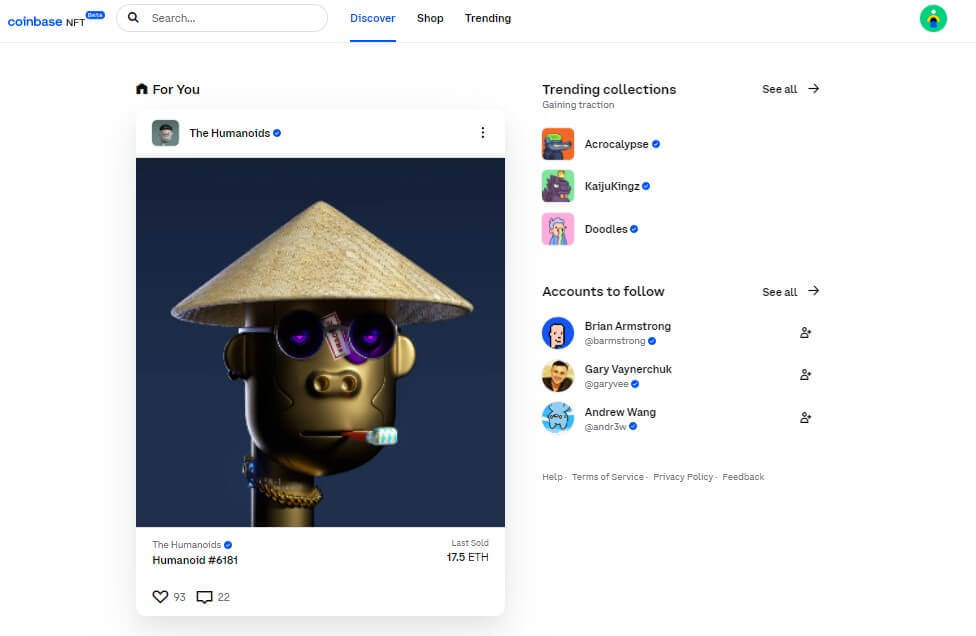
    The goal of the Discover tab in the Coinbase NFT marketplace is to enable creators and collectors to find each other. The Discover tab functions similarly to Instagram’s discover page; it curates NFTs across the platform and displays them to the user using the “infinite scroll” feed structure.

    The Discover tab is divided into two columns. The column on the left features the infinite scroll feed that serves up NFTs that users can click on to purchase or interact with using the “like” and “comment” functionalities. The column on the right has the following features:

    • Trending Collections: This displays the top three NFT collections on the platform (by volume) and has a “See All” button which users can click to load up the “Trending” page, which has a ranking of all the NFT collections on the platform.
    • Accounts to Follow: This displays three of the most popular accounts on the platform and has a “See All” button that users can click on to discover more accounts. 

    Shop

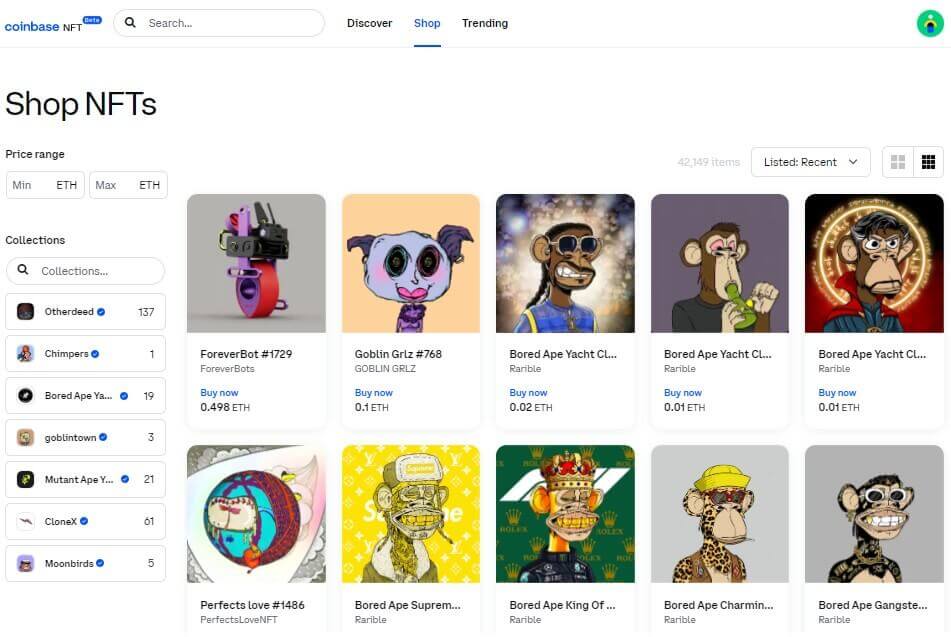
    coinbase nft shop

    The Shop tab is the core of the Coinbase NFT platform. This is where the tens of thousands of NFTs on the platform are available for users to view and purchase. The shop tab has a filter that allows users to:

    • Set a minimum and maximum price in ETH
    • Browse through collections – the top seven collections by volume are listed beneath the search bar.
    • Change NFT layout:
      • Recent
      • Oldest 
      • Lowest price
      • Highest price

    Like its competitors, Coinbase NFT has some high-profile NFT collections available, with the most notable being the Bored Ape Yacht Club Collection.

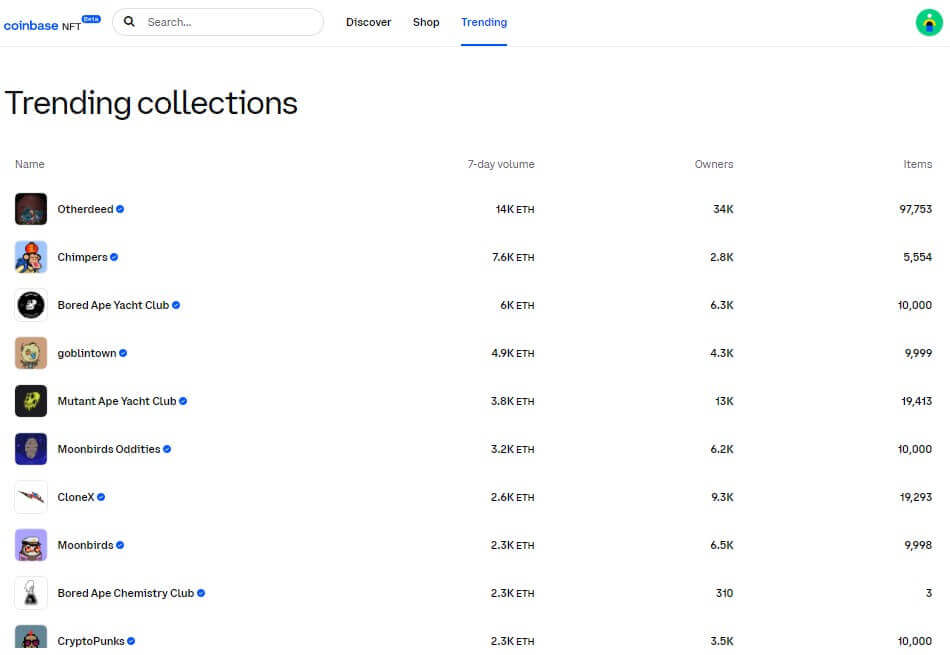
    Trending

    coinbase trending nft

    The Trending tab ranks all the NFTs on the platform using their seven-day volume. The NFTs’ stats are listed using the following categorizations:

    • Name
    • Seven-day volume
    • Number of Owners
    • Number of Items

    What wallets does Coinbase NFT support?

    Coinbase NFT exchange supports three wallets:

    • Coinbase Wallet
    • MetaMask
    • WalletConnect

    No plans have been announced to add more wallets, but these three will cover a large percentage of the Coinbase NFT user base so there’s probably no need for them to do so.

    Connecting a wallet to Coinbase NFT is the same for Coinbase Wallet, MetaMask, and WalletConnect. To get started with Coinbase NFT, the user will follow these steps:

    • Load up the Coinbase NFT website.
    • In the top-right corner, click “Sign In”.
    • A pop-up menu will appear with all three wallets that can be connected to the exchange.
    • Select the relevant wallet and confirm any requests from the wallet to connect to Coinbase NFT.
    • If the user doesn’t have a listed wallet, Coinbase provides a link to create a Coinbase Wallet in the “I don’t have a crypto wallet” section of the popup menu.
    • Upon clicking “Create a new Coinbase Wallet,” a new tab will be opened in the user’s browser that loads up a Coinbase Wallet extension download page. 
    • Follow the prompts to download the wallet and fill in all the necessary details to complete registration.
    • Once the wallet is created, return to the Coinbase NFT page and click on “Sign In”.
    • Click on the “Coinbase Wallet”.
    • In the browser extension popup, sign in to the Coinbase wallet and authenticate the connection between Coinbase NFT and the Coinbase Wallet.

    With that, the Coinbase Wallet is linked to the Coinbase NFT platform.

    How do I buy NFTs on Coinbase NFT?

    While purchasing NFTs is simple and similar to what you’ll find on other platforms, the method of discovering NFTs on the Coinbase NFT marketplace is different. On the Coinbase NFT marketplace, there are three ways to discover NFT collections:

    • Discover page (the user’s feed)
    • Shop page
    • Trending page
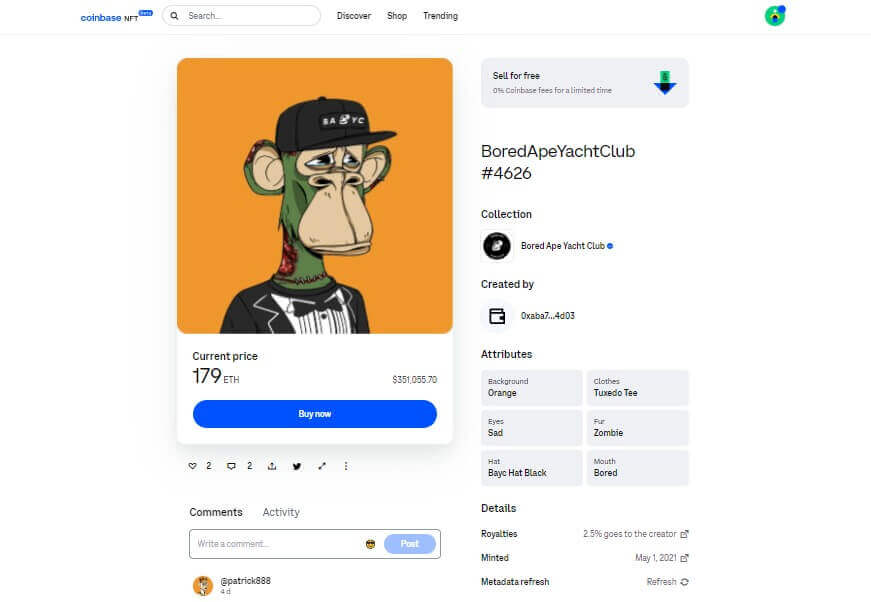
    coinbase nft sale page

    Once a desirable NFT has been located, simply click on the NFT to load up the NFT sale page. Once on the page, the process is similar to other NFT marketplaces, with the NFT purchasing page featuring identical details to other platforms:

    • Number of copies
    • Royalties
    • Mint date
    • Number of owners
    • Comments
    • Activity

    Coinbase NFT does not currently support auctions, so all NFTs are only available for fixed-price instant purchase. To make an instant purchase:

    • Click on the blue “Buy Now” button.
    • A Checkout tab will appear on the left part of the screen detailing the price. If the connected wallet does not have enough ETH to cover the purchase, the checkout tab provides a link to purchase ETH on Coinbase’s cryptocurrency exchange.
    • Click on the “Open wallet to pay” button at the bottom of the screen. The wallet popup will display the NFT price and gas fees to be paid.
    • Authenticate the payment and it’s yours!

    How do I sell NFTs on Coinbase NFT?

    According to Coinbase, every NFT listed for sale must comply with its terms of service or have a smart contract that can be traced back to the original creator, so bear that in mind before you try and sell on the exchange.

    To list an NFT for sale on Coinbase NFT marketplace, follow these steps:

    • Click on the profile icon in the top-right corner of the screen.
    • Click on “Profile”.
    • Click on “Manage NFTs”.
    • In the drop-down menu, click on “Created”. All NFTs connected to the Coinbase wallet will be listed there. 
    • Click on the NFT to be listed for sale.
    • Enter the sale amount in ETH.
    • Click “Confirm price”.
    • Follow the prompts to complete the NFT listing.

    Coinbase doesn’t currently support the minting of NFTs, although users can access NFTs minted or purchased on other platforms (e.g. OpenSea, Rarible) stored in their Coinbase Wallet. They can then list those NFTs for sale on the Coinbase NFT exchange.

    Conclusion

    Coinbase has taken a unique approach to how NFT exchanges can be structured and what goals they can pursue. If implemented well, the Discover page could be a goldmine for new creators by providing free advertising for NFT collections that would otherwise remain unknown, while the “Shop” and “Trending” pages also provide tools that simplify the search process for users and make it easier to discover outstanding collections.

    The only negatives associated with Coinbase are the inability to mint NFTs, but this is very likely coming soon, as is an ‘auction’ feature. The fact that Coinbase NFT only caters for the Ethereum network could also be considered a downside, although it is not alone in this.

    Overall, Coinbase NFT is a breath of fresh air in the NFT space, and if Coinbase digs in and invests in the development of new features to reinforce and expand the communal feel of the platform, Coinbase NFT exchange could become a town-square for the NFT industry for years to come.

  • Rarible

    Rarible

    Complete review of the NFT Marketplace Rarible

    To get into this Rarible review, let’s see where it all started…

    Launched in 2020, Rarible is a platform for the trade of non-fungible tokens. Rarible is bringing NFT creators and collectors together, becoming one of the top platforms where people go to publish their NFT collection, collectors come to mint, buy and sell new non-fungible tokens. 

    From Photography, music, domains, DeFi ( Decentralized Finance), Art and the Metaverse, Rarible has got all of the Non-Fungible Tokens most people are generally looking for. Another bonus on top of all of this is that the fees are low and reasonable.

    Now, to get into the real review! We are going to cover everything about the Rarible NFT marketplace, how to sell on Rarible, different Rarible prices, what Rarible is and how to use it as a whole! 

    What is Rarible and how can you start using this marketplace?

    Unlike other NFT platforms, Rarible’s main focus is a middle man between not just everyday NFT’s, but mainly the rare types. There is huge volume traded on this platform every day, and it’s down to its rare NFT access set-up nature and popularity, making this the HubSpot for avid NFT collectors. 

    The blockchain technology that protects users and Rarible is a great feature and a necessity when it comes to platforms like this, to ensure everyone’s safety. This is done via smart contracts and the fact that your NFT’s are Non-custodial, meaning your NFT’s will remain in your wallet until it is bought through the platform! We would say the only real safety breach is usually from other people phishing. If someone claims they are from Rarible and wants a seed phrase or sensitive information, it is more than likely bogus so report them and ignore them! The Rarible team will never message you for phrases or sensitive info.

    Rarible is great for top tier NFT holders and collectors. The main reason sellers benefit from this platform, in particular, is that the Rarible marketplace is a space that allows creators and traders to earn royalties on NFT’s, this opens a new avenue for revenue you can produce passively, this is, of course, a very attractive proposition for users.

    This trustworthy platform has built a great name for itself over the short time it has been around, the technology and system they have in place has earned its respect and we recommend checking it out if the trading of rarer NFT’s is something you are looking for. It’s got tens of thousands of users and not only can you buy/sell Rare NFT’s, go ahead and check out how to safely sell and create your own NFT on the platform using smart contracts and their wicked and user friendly technology.

    What is Rarible?

    There are some new, unique and fantastic things that the Rarible team is doing. To get started and dive right into the Rarible review, let’s cover the RARI coin. In July 2020, Rarible launched the first NFT based Governance token ever made, called RARI. The token is worth more than 10x its launch price at the moment, so all of you crypto junkies, I’d highly recommend giving this a look as an avid coin collector, and if you have some already, more power to you!

    What makes their RARI coin so unique and able to add value consistently is the fact that the token can not be purchased, instead, it has to be earned on the platform by taking part in the trade of NFT’s. The market cap of this trading platform has reached over $30M to date.

    Possibilities in the NFT realm are almost endless with what you can tokenize these days, and Rarible is no stranger in capitalising on this potential and helping those on the platform do so as well. Most of us know of the Art based NFT, mostly visual digital canvas form. As mentioned before, there is a huge range of NFT’s they also cover. 

    • DeFi 
    • Metaverse
    • Music
    • Games
    • Domains
    • Photography 
    • Art

    The fees on Raribles platform are fair but some platforms are better, depending on how you look at things. The 2.5% Fee is a standard, but some users are upset that Raribe charges both buy and seller a fee, rather than some platforms which only charge one party. It’s not a big deal or problem in my eyes, especially for the service and dedication that has gone into this free to browse platform.

    Gas fees are a consistent battle for all collectors and creators of NFT’s. Other platforms have tried to tackle the high gas fee issue by launching minting options that do not require a gas fee, when your NFT is made this way, nothing is submitted to the ledger. Smart contracts have allowed transactions to only take place when someone buys it, therefore it’s in your wallet and doesn’t leave your ownership until sold.

    What is the Rarible Marketplace about?

    Avid NFT collectors, creators and enthusiasts, Rarible is your platform. Based on the Ethereum blockchain, the NFT marketplace allows and facilitates the creation, purchase and sale of ownership rights to Non-fungible Tokens such as Defi, Metaverse, Music, Memes & Punks, Games, Domains, Photography and Art. 

    For artists and creators, Minting your own NFT’s through Rarible is very much possible, if that’s what you are looking to do. When it comes to a successful Mint, you are not required to sell them and can keep them stored on the Rarible platform. There are some fees involved when it comes to Minting for the first time, one that gives your wallet permission to interact with Rarible, and one which puts your file on the IPFS, or InterPlanetary File System, and the Ethereum blockchain.

    How Does Rarible Work?

    Rarible has some simple steps to follow when it comes to the workings around everything on the platform. The main objective is to allow creators, sellers and buyers to synergise systematically in a fairway. 

    For creators, turning their work into an NFT, the first step is to ‘Mint’ by filling out a form, located on the website which presents the options of listing their price, data, info and attaching their image. Once all is done, the platform will interact with the Ethereum blockchain, allowing the transferring of the art, which is now tokenized. The Ethereum blockchain that is used in the final step, has code that will provide a full history of the ownership of the NFT, and is set up to prove ownership and can be an income source through the royalty system embedded in the code. 

    The royalties provide potential future cash flows within the NFT’s for the creators. This is done through the NFT code, which has an embedded command allowing royalties of up to 50% of all future sales of the particular NFT once it has swapped hands initially. 

    This feature is a magnet for creators because, unlike other platforms, these NFT’s can pay out the royalties right away, being much more beneficial for creators to use this platform.

    What Wallets Does Rarible NFT Marketplace Support?

    Rarible is on the Ethereum blockchain and supports top trusted Ethereum wallets such as Coinbase, Metamask, Torus, Portis, Walletconnect or Argent. Plus a handful of other trusted Ethereum blockchain wallets. You can load up your wallet by either transferring pre-existing Eth you may have on the wallet, transferring over from another wallet or using the platform’s credit card payment option.

    If you are looking to purchase right away, linking your wallet will be the first necessary step to access and browse the Rarible NFT Marketplace. 

    How Can I Link My Wallet to Rarible’s Platform?

    You will need to make sure this is complete if you want to Buy or Sell on Rarible.

    First and foremost go to Rarible.com, look at the top right corner of the online browser website and select the ‘Connect Wallet’ Option. A handful of Eth wallets will appear, select which one you have or create a new account. If you are going to create a new account, we would recommend Metamask as it is the most popular and trusted wallet on the Ethereum blockchain.

    Going down the Metamask route, here’s a quick guide. First of all, select ‘Metamask’ as your wallet of choice, the Chrome wallet extension will slide down from the top right corner, click ‘Next’ and then ‘Connect’. If you require creating an account, follow the steps, or connect your pre-existing account. The next step is to select the ‘V’ sign on the terms and conditions, confirming you are over the age of 13 and that’s it, you have successfully connected your Metamask wallet to Rarible.

    How Do I Buy NFTs at the Rarible NFT Marketplace?

    So, you have connected your Rarible wallet and are raring to go! What’s the first step, and how do you go about buying an NFT?

    First of all, you will need to browse the NFT listings, either on the explore page or search for a specific NFT if you know the name of the collection. Once you stumble upon the NFT you desire, and your wallet is connected, you can use Ethereum to purchase the NFT. 

    Depending on how the seller/creator has listed their Non-fungible token, you can either purchase through an auction or ‘buy now’ at the listed price. You can always place a bid on the NFT, below the price but it will be up to the owner whether they will accept your offer, or not! 

    How Do I Sell on Rarible?

    So, you are not so much of a buyer, but you want to sell on Rarible! You have come to the right place. Your first sale may be very profitable, the start of something new and significant, or something else. Either way, here is how you do it! 

    You can either take your minted NFT and sell on Rarible, or pre-owned from somewhere else, such as if you are an avid collector, and have stored it on your Ethereum blockchain wallet. 

    Press ‘Sell’ and you will be presented with some options.

    • Open Auction – Your NFT will be ‘Open for bids’. Anyone can make you an offer at any time, it is then up to you to accept or simply decline their offer.
    • Timed Auction – With this option, your NFT will be listed and sold to the highest bidder at the end of the auction. It’s up to you to set starting and ending auction listing times, as well as a minimum price that you’d be comfortable selling at if the auction isn’t too successful. If the price is bumped up in the last 10 minutes, the auction is extended, giving you a good chance for more offers.
    • Fixed Price – List your NFT at a price you want, people can send you offers below this price or simply buy it for your listed price.

    Conclusion

    This Rarible review has been fun to do, I have learned much more myself, and I hope you have too! 

    The platform is highly trusted, popular and backed by a huge community. There is no reason why it wouldn’t be in your top NFT platforms list already, and if you are new to the NFT space or only just hearing about Rarible, it’s worth checking out and researching! 

    The team and creators have had and successfully pulled off their goals from the start, it’s going to be interesting watching the progression of this platform continue. I’m sure they will continue to impress us and keep everyone’s eye on them.

    All in all, the main concerns about usability and fees are not too bad here and are probably one of the best go-to marketplaces out there as of now.

  • OpenSea

    OpenSea

    OpenSea: in summary

    Opensea launched in December 2017 as an alpha on the Rinkby testnet, eventually migrating to the mainet in 2018.  The platform has had huge success becoming the most popular marketplace with over 600,000 people signed up, over 2,000,000 NFT collections listed on the site, over 80,000,000 NFT’s in those collections and a trading volume of over $10 Billion!

    This site has dedicated time, effort, blood sweat and tears to get its operation to where it is now and this is why it is number 1. 

    The NFT marketplace is relatively new and OpenSea have made their mark on the market already, we expect to see them at the top for quite some time.

    OpenSea Marketplace Overview

    The Opensea Marketplace was Founded in 2017 by Devin Finzer and Alex Atallah, these two came together into the crypto NFT marketplace and started by simply talking to users in Discord communities and decided to create an open marketplace we now know today as OpenSea.

    OpenSea is a platform you can easily navigate through. Signing up is simple, with a step by step process that you can follow with ease. 

    Logged in or not, you can browse the NFT’s that are listed on the platform, they have many different options available for you to have a play around with and have everything laid out in a manner that once you have had a go with the site for a while, you will pick it up quite quickly.

    OpenSea Review

    Starting the Opensea review, what is the Opensea Marketplace?

    OpenSea is the biggest, most popular and user-friendly NFT market out there. 

    We don’t know what is in store for the future regarding NFT Markets but what we do know is that people from all skill levels will be able to easily browse, buy, and sell NFTs at OpenSea

    From collectors to creators, this platform allows users to decide where they want to go with their NFT journey and how they will do it. 

    OpenSea, is a well put together but simple landing page. Unknowingly what to look for, there is a neatly placed ‘Explore’ button at the top and just below it was something that seemed to be an endless Rolodex of NFT collections which all looked so different, interesting and a little bit confusing.

    Collections are laid out in a professional manner which are easy to understand and things quickly make sense for most users. Words such as ‘Floor Price’, ‘Volume Traded’, ‘items’ and ‘Owners’ on the website are not too hard to wrap your head around and understand. After a little while of browsing, surfing and playing around, you should be able to get the hang of things. Knowing what NFT’s to buy, that’s a whole different question, but what the platform helps you understand is what the NFT’s are, how the system works, how they are traded and how to buy/sell using their platform.

    I think all a developer of digital marketplaces wants is a user-friendly utility that is so simple to understand a grandmother could use it and in all fairness, they have not come far off that ease of usability.

    When it comes to setting up your collection yourself on there and listing your NFT’s to Mint, that seems much more of a daunting task. 

    There is without a doubt an easy to follow, step by step process from the first click of the ‘Create’ button on the home page, and an easy plug-in wallet connection such as ‘Metamask’. The best way to tackle this I’d say is to have a youtube video guide side by side the platform and watch and implement at the same time. This will ensure you do it correctly by learning from someone else’s mistakes, save you a lot of hassle and speed things up. The platform has everything you need to list your collection, understanding it is more of the task at hand when looking to create your NFT collection via OpenSea. 

    How Does OpenSea Work?

    To get started with the OpenSea Marketplace, you will need to make sure you have a wallet connected. You can use the following wallets with OpenSea: 

    Once your wallet is connected you are ready to get started bidding or buying NFTs from the various collections at OpenSea. 

    When you post your listing, there are things to keep an eye out such as currency and price, always make sure you double-check this. 

    By double check, I mean make sure you DO NOT add or remove unnecessary 0’s to the listing price… It wouldn’t be the first time it happened, one BAYC sold for $3000 rather than the $300,000 it was meant to be listed for! Check out the story here.

    If the purchase is successful you will receive an email and OpenSea will take a 2.5% fee on whatever the final sale price was.

    OpenSea is a decentralised platform and its NFT technology runs on the Ethereum blockchain. Users can use Smart contracts to engage with the platform.

    Their focus is predominantly matching artists / sellers with buyers, they are the middle men hence the fee.  

    Opensea has good usability across all devices, for desktop the website opensea.io is good enough, but for mobile we would recommend using their app which can be found in the google play store or apple store.

    What Features Does the OpenSea Marketplace Have?

    The sole purpose of this platform, which out of any others it does best, is its ability to create, set up, sell, exchange and auction NFTs! 

    This platform allows usability like no other, you can create NFTs and trade ones that are already on the platform. 

    These NFTs are in the forms of Trading cards, Music, Collectibles, Art, Sports Assets, Domain names and membership passes. 

    That’s just to name a few uses for the OpenSea marketplace; in reality there are plenty more!

    With OpenSea being the number one marketplace for NFTs, there is without doubt access to the widest and largest number of people in the NFT space. 

    This makes OpenSea, when selling and buying NFTs, the best place to go and gives you the highest probability you will have success with your goals.

    The OpenSea Marketplace has a great deal of statistics and data for every NFT that is listed on their platform, meaning you can always keep track of the latest and highest achieving NFTs. 

    This is great for everyday people, people who want to flip NFTs or even keep track of one they may own on a collection. 

    There are 150 cryptocurrencies you can use on Opensea to transact. This should give most people at least one option and little hassle when starting out trading on the OpenSea platform. 

    Fee’s are pretty low, not the lowest industry-wide but more than reasonable, especially with the client base they have.

    When it comes to purchasing an NFT, no matter which platform, there will be a relevant fee involved, usually a percentage of the purchase price which is paid by the buyer in most cases.

    Opensea charges the buyer the fee of 2.5% to the platform in each NFT transaction. As a sellers market, there are no Listing fee’s, the creator can also stack royalties on the NFT meaning in any case of a transaction, they will make a percentage. 

    There are Opensea gas fee’s which you should take into account, these are due to the Ethereum market and are called ‘Opensea Gas fees’:

    • Accepting an offer
    • Transferring / Gifting NFT
    • Buying an NFT
    • Cancelling a listed NFT
    • Cancelling a bid
    • Converting WETH back to ETH, and vice cersa
    • Freezing your metadata
    • Bridging or Withdrawing ETH to and from Polygon

    What Wallets Does OpenSea Support?

    You can use the following wallets with OpenSea: 

    Once your wallet is fully connected and established you are ready to get started Minting, Bidding or buying NFT’s within different collections on the market. 

    The wallets Opensea have picked are regarded as the top performers in terms of security, which is the first priority with any crypto trading.

    If you don’t have a secure wallet, or share your info, you are at risk of being hacked, resulting in losing crypto and NFT assets.

    The most secure option when using Opensea is to have a hardware wallet such as Ledger, using this with Metamask will synergise your experience and most importantly, safety. 

    To start with OpenSea, you will need an Ethereum wallet. This will allow you to hold and store your Cryptocurrency and NFT’s. The most common currencies used on OpenSea for trading NFT’s are ETH/WETH.

    Go to the collect wallet tab on OpenSea, then choose which type of wallet you are connecting to the site – we recommend Metamask

    Once connected, you will need to sign for approval and confirm that you want to connect with OpenSea.

    Once connected, go ahead and fill out your information settings such as Username, Email address, socials, bio etc.

    You are now connected and ready to start trading on the OpenSea market!

    How Do I Buy NFTs at OpenSea?

    Now you have your OpenSea wallet set up, how do you buy an NFT? It’s very simple and here we will walk you through, step by step.

    Upon sign-in, you will be presented with an explore tab or you can manually search in the bar for a particular collection. 

    You could even browse the top charts and see if any of the top performers on OpenSea, such as BAYC, tickle your fancy. 

    Once you have found and chosen the perfect NFT for you, you must select it and then decide if you want to make an offer or buy it directly from the seller’s listed price. 

    Whichever one you choose, you will need to sign off the transaction from your connected wallet. 

    If you choose to make an offer, assuming it’s not ridiculously undercutting the value, although that does work in some rare cases, you will have to wait until the seller either rejects or accepts your offer. If you want to cancel your offer after it has been made, you will need to pay a gas fee. 

    Opting to place a bid will give you a chance to get an NFT than buy it now / floor price, this works best when demand for the collection is low.

    If you decide to ‘Buy Now’ the transaction will take place straight away and you will not need to wait. Your NFT will be sent over to your wallet within a few minutes! A small gas fee will also apply to this transaction. 

    Whichever way you go about purchasing, you can always check at the end of the transaction if everything went smoothly by going to the OpenSea Menu > Account > Profile, and then taking a look at the ‘Collected tab’. 

    This will display your beautiful assortments of NFTs on the particular wallet set up with that account! 

    How Do I Sell NFTs on the OpenSea marketplace?

    OpenSea is the hub when it comes to creating a collection, listing it and having a mass auction to your community. 

    That’s not all… OpenSea allows you to list NFTs from your Ethereum wallet from other collections that you may have. 

    To get started with selling an NFT on OpenSea, first, go to menu > account > profile. Here is where you will choose the NFT you want to sell on Opesea marketplace. 

    Select the NFT and then the ‘Sell’ button. Set your price and finally, schedule your listing. You will see a bunch of options you don’t have to worry about too much but make sure you play around with them to get a feel of what’s going on. 

    You will also see the Opensea fees displayed on the bottom.

    When getting into listing your NFT for sale, you can choose from four options. 

    1. Fixed Price sale: this is where you set the price you want as ‘Buy it now’, similar to eBay, and the listing will wait until someone decides to buy it out at the listed price.

    2. Dutch Auction: in this sale format the auction will start at a high price and end lower, closer to floor price gradually over time until the end of the listing has finished. 

    3. Normal Auction: you will start with a price and a ‘reserve price’, list your auction for a minimum price and people will bid against each other until you decide to accept an offer or time runs out.

    4. Bundle sale: listing multiple NFT’s at once is possible with this option, usually to the same buyer. This is one transaction with multiple NFT’s sold at one time. This saves the buyer Opensea gas fees.

    One cool feature about being a seller with OpenSea is that you can set a royalty of up to 10% on each NFT sold if you are the original creator. This means you earn revenue on every NFT transaction if you created it.

    OpenSea Review Conclusion

    Clearly from reading this OpenSea review, we can tell it is the godfather of all NFT trading platforms, and with its user base, revenue, collectors and creators, it’s easy to see why it is number one and doing so well today.

    If you are looking to get started in the NFT markets, OpenSea should be your first port of call.

    Whether you want to become a creator, collector or simply browse a wide range of beautiful art and creative utility, OpenSea is the place to go. 

    Why not head over there now? I can guarantee you will stumble upon something that catches your eye! 

    The Opensea Fees and Opensea Gas fees are probably some of the best I have seen throughout all NFT platforms.

  • Magic Eden

    Magic Eden

    MAGIC EDEN: In Summary

    Magic Eden is a Solana NFT marketplace whose goal is to make minting and trading NFTs easy, low cost, and super fast. The marketplace, which launched in early 2019, holds a majority share of the NFT market on Solana.

    Magic Eden is recognized as the best and most popular independent Solana NFT marketplace, with the exchange claiming to have over 10 million unique monthly visitors, boasts over 4,000 NFT collections and 100,000 daily wallet connections, and supports some $1 billion in secondary trading volume.

    The exchange offers its users a wide range of features, including the most popular new and upcoming Solana NFT collections, a launchpad, a trove of statistics, an auction feature, and a thriving community. However, Magic Eden suffers from a lack of variety in the NFTs for sale, while the website itself can be buggy. There is also the concern over a forthcoming integration of Solana NFTs into the world’s biggest NFT marketplace, OpenSea, that could also take traffic away from Magic Eden.

    Magic Eden

    Magic Eden Review

    NFTs present an opportunity for creators to monetize their creations and build a community around their art. To date, Ethereum has been the blockchain platform of choice for NFT marketplaces which is why it is the core offering for NFT marketplace giants like OpenSea, but that has begun to change. 

    As transaction costs balloon and transaction times slow on Ethereum, creators and traders have craved faster speed and lower costs. This demand has spurred the rise of NFT platforms that leverage other blockchains’ speeds and low costs. One such blockchain is Solana, with its premier NFT marketplace Magic Eden ranked as the number two NFT Marketplace after OpenSea in terms of volume.

    Aside from offering the aforementioned benefits, Magic Eden also solves the issues that limit competing platforms by incorporating a Launchpad minting process, which filters for the most viable projects to add to its exchange. It has also positioned itself as a much more accessible NFT Marketplace by selecting projects that are more affordable that the likes of OpenSea. 

    Magic Eden has simplified the minting and trading process for NFTs, opening the floor to creators and traders to experiment with this new asset class. By offering a simple and intuitive interface, low costs, and an easy to navigate NFT categorization structure, backed up with great support, it’s no surprise that Magic Eden has built a community of eager enthusiasts and does such a roaring trade.

    What is Magic Eden?

    Magic Eden launched in early 2019 as a decentralized application (DApp) NFT exchange built on top of the Solana blockchain, utilizing Solana’s fast transaction speeds and low fees. Magic Eden’s backers include Coinbase Ventures, Solana Ventures, and Alameda Ventures with Sequoia Capital also taking a stake in the project, giving them a strong financial base from which to build.

    Magic Eden allows users to buy, sell, and mint NFTs, which can represent anything from digital artwork to gaming items. Since its launch in 2019 Magic Eden has seen a steady influx of new and returning users, with daily wallet connections now regularly in excess of 200,000 and close to $1 billion worth of transactions taking place per month on the platform.

    NFT transactions on Magic Eden are similar to Ethereum-based marketplaces like OpenSea, with the major exception being that Magic Eden leverages the low costs of the Solana blockchain to offer users a package that includes a 0% listing fee of only 2% for transaction fees. Such low operating costs reduces the entry barrier for novice and seasoned NFT buyers and creators, while the project’s Launchpad feature ensures that this doesn’t result in low grade work flooding the platform.

    What is Magic Eden’s Launchpad feature?

    Magic Eden’s Launchpad is a screening mechanism for new NFT projects and was the first such process within the NFT exchange sector. The Launchpad filters out poor quality projects and ensures that only projects that adhere to certain criteria are listed on the Magic Eden marketplace. The requirements are as follows:

    Completed submission form: Without a completed submission form you aren’t going to make it very far with Magic Eden. The platform automatically rejects forms with omitted answers.

    Full collection minting: The Magic Eden marketplace does not support pre-mint campaigns or whitelisting, so creators have to launch their entire collection at once. 

    Randomized fixed price minting: Magic Eden allows creators to set a total price for their collection, which the platform then spreads across the number of NFTs in the collection.

    A clear roadmap: Magic Eden Launchpad requires creators to submit a roadmap to prove they have a long-term vision for the project.

    Community-focused: Creators must show how their project benefits the Magic Eden/Solana communities rather than simply being a route to riches.

    Should creators clear this hurdle they then meet with the Magic Eden team to discuss next steps and launch details. Magic Eden also insists on a test launch on devnet to ensure the collection has no technical issues prior to launch. Only once all these stipulations have been met can a project launch on Magic Eden, which results in a marketplace that is robust and reduces the risk of a ‘rug pull’ as much as possible – where creators take swift profits before abandoning the project.

    It hasn’t managed to avert these entirely however. The first rug pull on Magic Eden was the King of Chess NFT collection, which was supposed to be an NFT chess game. The project launched in January 2022, but instead of putting investor funds towards building the game as was promised, the developers stole 645 SOL, worth $58,000 at the time. 

    A second such event happened a month later with the Balloonsville NFT scam, which saw the developers disappear with 5,000 SOL following their abandoned project, worth $600,000 at the time.

    Following this second scandal, Magic Eden paused its Launchpad service and upgraded its security features to ensure such scams do not occur in the future. One such feature is the stringent Know-Your-Customer (KYC) requirements that developers must now undergo to privately identify themselves to the company. 

    Secondly, the developers will have to sign a partnership agreement with Magic Eden upon approval.

    Magic Eden also began to:

    • Focus on fewer launches per week to improve the quality of projects on the platform
    • Require that the developers prove they are experienced enough to be running an NFT project with real social engagement.
    • Require developers to submit a whitepaper and “realistic” roadmap
    • Hold investor funds in escrow for at least 24 hours and encourage developers to increase the escrow period to 14 days for developers who want to go the extra mile to prove their authenticity

    What Features Does Magic Eden Have?

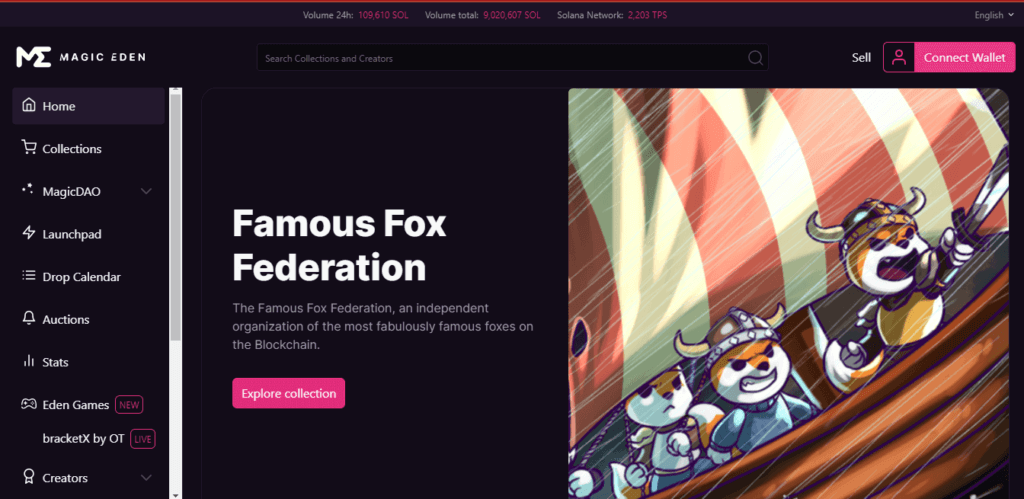
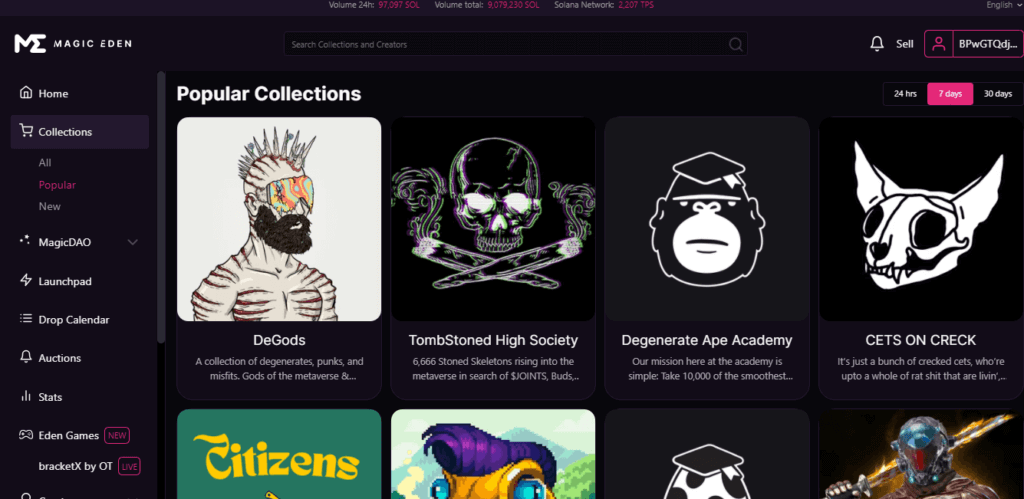
    Popular Collections: This is a curated list of the hottest projects on the Magic Eden platform. This feature is in its own category, meaning that users don’t have to search endlessly or tweak search filters to find the trending projects on the platform. With this feature, users can easily browse, learn about, and invest in the hottest projects on Magic Eden.

    Magic Eden collections

    Upcoming Launches: With this feature, Magic Eden provides users with a curated list of upcoming launches to lookout for. The marketplace links directly to the Twitter pages of the projects to make research that much easier.

    Launchpad: As already alluded to, the Launchpad function is one of the most interesting features of Magic Eden, with the exchange being the first to offer such a mechanism. Launchpad empowers users to create NFTs in minutes without prior NFT or development experience while also ensuring that only genuine NFT creators get a berth on the exchange.

    Attributes Filter: Like the filters on other platforms, Magic Eden’s attributes filter allows users to filter for the most exciting features in the NFT collection they are browsing through.

    Stats: Magic Eden lets users instantly see the complete supply, category, and overall worth of their digital assets once they have connected a wallet. 

    Auction: Magic Eden has a standard auction feature which allows users to bid on NFTs reflecting what they perceive the true value to be. The holder is then alerted and can either accept or reject the bid.

    Community: Magic Eden is community-centered. It places a lot of value on feedback and suggestions from its community, which has been reflected in the announcement of a Magic Eden DAO in February 2022 which will allow the community to guide the project once it is fully established.

    What Wallets Does Magic Eden Support?

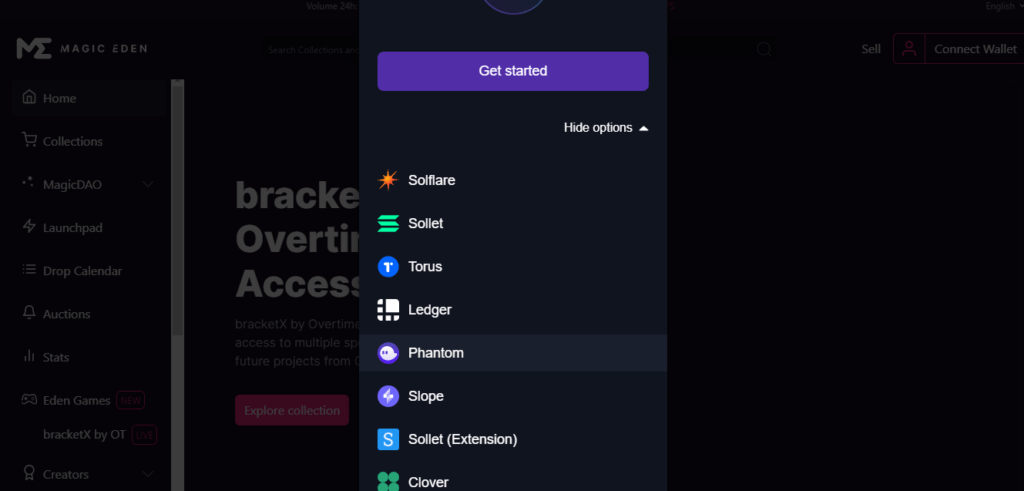
    Magic Eden supports a number of Solana wallets, including:

    • Solflare
    • Sollet
    • Torus
    • Phantom
    • Slope
    • Sollet
    • Clover
    • Coin98
    • Solong
    • MathWallet
    • Glow

    How Can I Link My Wallet to Magic Eden?

    Magic Eden wallet

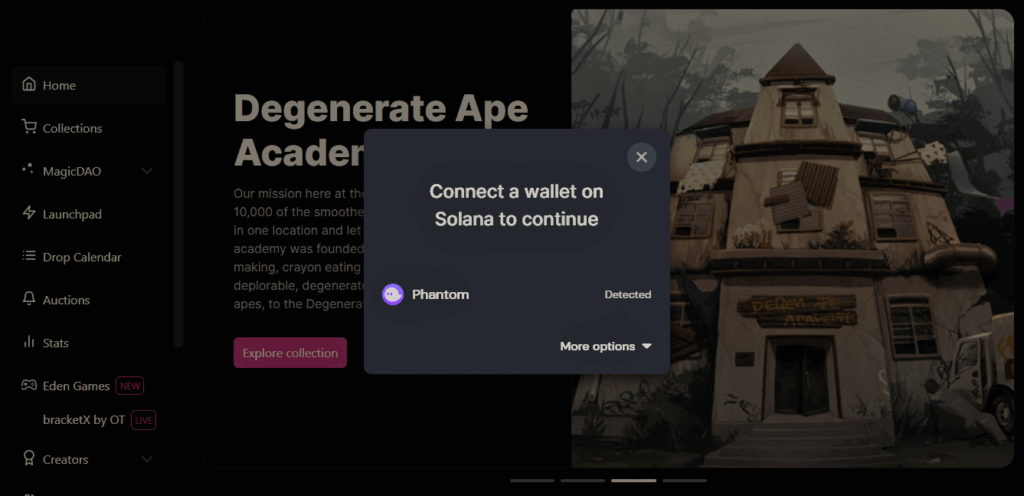
    To connect a wallet, follow these steps:

    • Click on the “Connect Wallet” button in the top right corner of the screen.
    • In the tab that appears, click on the “Options” button to choose your preferred option.
    • Follow the prompts to register your wallet and make any necessary downloads.
    • Once you’ve created your wallet, return to Magic Eden’s homepage and click the “Connect Wallet” button again.
    • The system should detect your wallet. Click on the wallet to connect it and create your Magic Eden profile.
    Magic Eden solana

    How Do I Buy NFTs at Magic Eden?

    Magic Eden how to buy

    In order to buy Solana NFTs at Magic Eden you first need to connect your wallet. You will find the “Connect Wallet” button in the top right corner of the screen. Follow the prompts to connect your wallet. You may find that it takes several attempts to connect your wallet – perseverance is the key. This is a small but annoying but that really could do with ironing out on this otherwise bug-bree Solana NFT marketplace..

    You will now find the “Collections” button on the menu in the left corner of the screen. There is a shopping cart image right beside it. Clicking on it will activate a drop-down menu that includes the following collections: “All,” “Popular,” and “New.”

    Since most users are looking to buy Solana NFTs that will grow in value, the “Popular Collections” tab is the best place to start. It isn’t clear if the collections are listed by popularity, but instinct suggests that they are.

    Once you click on the collection of your choice, a page will open up that includes all the items for sale in that collection. You will find two tabs below the collection information at the top of the screen. One tab is titled “Items,” where all the NFTs in the collection are displayed, while the other tab is titled “Activity.” In the Activity tab, you will find information on previous sales that have been made for that collection.

    On the left side of the screen you will find the filters menu. You can activate filters based on price or attributes to find the NFTs that meet your specifications.

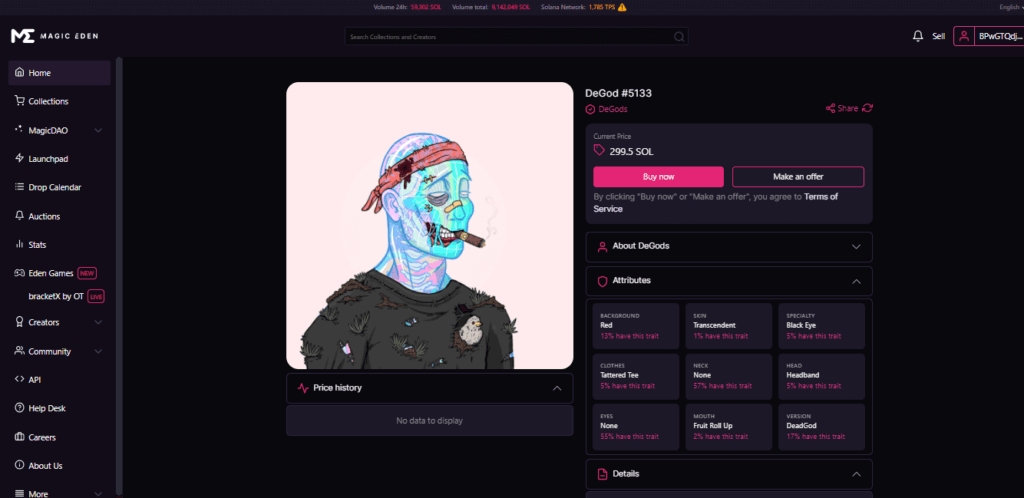
    Once you have found an NFT that you like, click on it, and you will be brought to the page for that particular listing. Here, you have two options – you can “Buy Now” at the seller’s asking price for an instant purchase or to “Make an Offer” to the seller. Be aware that if you want to buy Solana NFTs on Magic Eden you need to offer at least 50% of the listed price.

    If you choose to make an offer, you will have to wait for the seller to see it and respond to it before proceeding. If you choose to buy instantly however, a notification on your wallet will pop up with details on the transaction, including the transaction fee and the NFT’s details.

    Once you click “Approve,” your transaction will be approved within three seconds, after which another popup will appear at the top of your screen, stating, “Congrats! Your purchase is fulfilled.”

    Now you can find your NFT in your wallet and on your Magic Eden profile.

    How Do I Participate in NFT Auctions at Magic Eden?

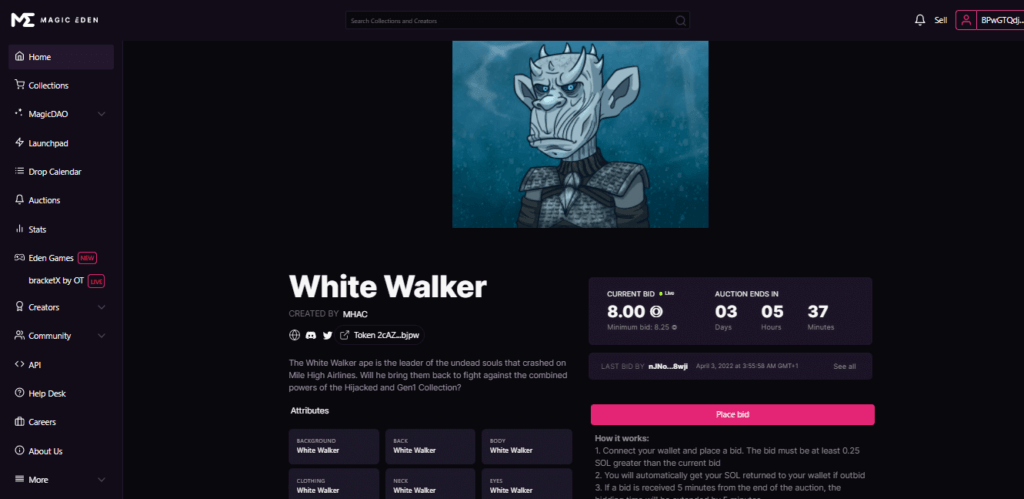
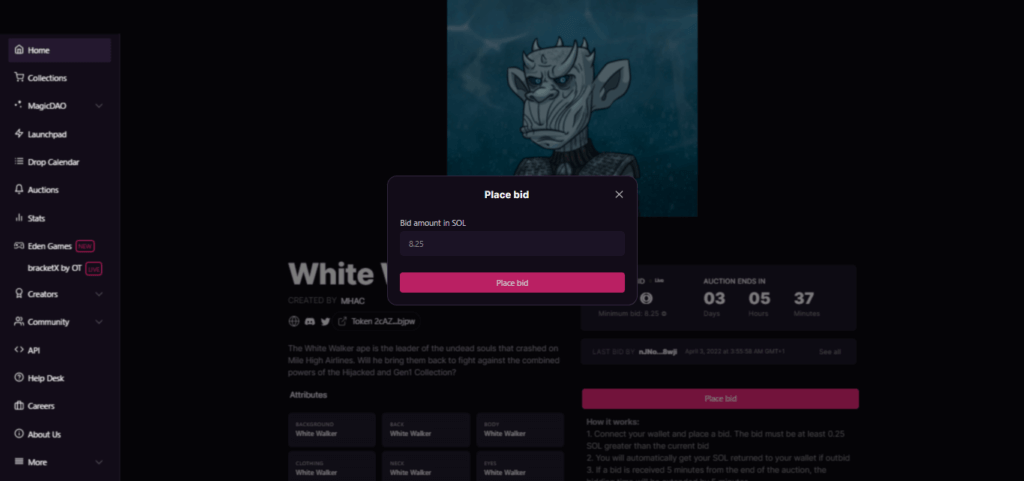
    The Auction feature presents a different way for you to buy Solana NFTs. Participating in auctions on Magic Eden is, as with everything on the site, intentionally simple. Look for the “Auctions”tab  listed on the menu on the left side of the screen. Click on it to access the Auctions page. On the Actions page you will find some NFTs listed there for auction, with the White Walker shown here as an example:

    Magic Eden white walker

    When you click on it, the Auction page for the NFT will be opened, and it will present you with information on the attributes of the NFT, its creator, and a live feed detailing all the bids made for the NFT.

    Making a bid is a simple process, but there are some conditions, one of which is that you must make a bid at least 0.25 SOL greater than the current bid. The instructions on the page also state that your SOL will be automatically returned if you are outbid.

    Magic Eden buy nft

    On the other hand, if you have the highest bid when the auction countdown ends, the NFT automatically becomes yours. All you need to do is click the “Claim Item” button, and it will be added to the list of items you own.

    How Do I Sell NFTs on Magic Eden?

    As one might expect, to sell Solana NFTs on Magic Eden is just as easy as buying. You will find a “Sell” button beside the profile icon in the top right corner. Click it, and it will bring you to the “My Items” tab in your profile, where all of the NFTs you own are listed. 

    Click any NFT, and the NFT sale page will be opened. The page contains all the details concerning the NFT, including fields you can fill to list your NFT on the marketplace.

    Right beneath the NFT image you will find a price chart that illustrates the historic price trend for the NFT. In the Details tab you will find information on the mint and token addresses, your address, the artist’s royalty, the 2% transaction fee, and the listing/bidding/cancellation fee.

    You will find a tab right beside the image of the NFT, which contains a field in which you will fill in the price you want for your NFT. For a pricing guide, review the historical price activity to understand how the value of the NFT has grown over time and check out similar NFTs on the marketplace and study recent sale prices. 

    Once you have decided what price is right, input it into the field and click “List Now.” Your wallet will notify you that it has started the listing transaction. Don’t forget that you will need some SOL tokens in your wallet to be able to pay the 2% transaction fee that gets leveraged when you sell Solana NFTs on Magic Eden.

    To complete the process, click on the “Approve” button in your wallet and the item will be listed on the marketplace.

    Once the item is listed, it will no longer appear in the “My Items” tab; it will now appear in your profile’s “Listed Items” tab.  If you click on it, it will open up the listing page, and from there you can choose to either cancel the listing or copy the link to the listing to share it.

    If you choose to cancel, the NFT will be returned to the “My Items” tab, and the transaction fee that was deducted will be returned to your wallet. If you go ahead with the sale, the NFT will no longer appear in your profile once it is paid for. All you will have is the deposited SOL in your wallet. 

    Conclusion

    Magic Eden stands out from the crowd because of its unique features, which have proved immensely popular with the NFT-buying public. This is testament to its vision, build quality, and  community strength.

    The Launchpad is the platform’s flagship feature, with other NFT marketplaces sure to follow Magic Eden’s lead in protecting users. Widespread use of correctly implemented Launchpad features, or something similar, will severely reduce, if not eliminate, the number of NFT scams in the space. Like all platforms, Magic Eden has experienced a couple of these, but it has bounced back quickly from such scandals and used the lessons learned to strengthen its platform and further protect its community.

    The only cloud on the horizon for Magic Eden is the integration of Solana NFTs into OpenSea, which could well see Magic Eden’s traffic leaving for its rival. However, the Magic Eden user base seems very loyal to this Solana NFT marketplace, and considering its mix of features, the affordability of its NFTs, and the enhanced trust that results from knowing that projects listed on the platform have been thoroughly vetted, there is a very good chance that Magic Eden will continue to more than hold its own in the battle of the NFT marketplaces.

  • Known Origin

    Known Origin

    Get to know where your goods come from when you shop at Known Origin. In this Known Origin review, we’ll take a look at what it offers.

    Known Origin is an online marketplace where you can buy Non-fungible Tokens or NFTs. These unique items can be minted (created) and sold here with collectors and creators all enjoying the same platform.

    Active since April 2018, Known Origin is owned by the crypto exchange, Gemini. It’s also based in the USA.

    This exciting marketplace offers a top range of NFTs, usually from well-known NFT artists. That being said, it’s still possible to find cheaper NFTs from lesser-known artists as well.

    To date, Known Origin has more than 9000 different artists on their platform with over 47,000 unique Known Origin NFTs. Impressively, this has resulted in more than $10 million in sales at this time.

    Though not one of the biggest NFT marketplaces, this one is growing, and growing rapidly. Recently, the most expensive Known Origin NFT was sold for $74.7k.

    In this Known Origin review, we will take a look at all the different features that make this marketplace one to watch.

    Known Origin Marketplace Overview

    knownorigin marketplace

    For our Known Origin review, we found that this platform originally started as a popup art gallery in Manchester. The goal was to showcase the application of using blockchain technology in the form of artwork that was tokenized on Ethereum.

    In this way, art and technology could be combined. This small event turned out to be an immense success and showed that tokenized artwork was in demand.

    From that point, founders David Moore, Andy Gray, and James Morgan developed the Known Origin NFT platform as we know it today. For this Known Origin review, we’ve found that their dedication has made it one of the fastest-growing marketplaces out there.

    As this is aimed at everyone, Known Origin offers a clean, simple interface with all the Known Origin NFTs being very easy to find throughout the site. Signing up is simple too, and that’s for both artists and buyers.

    Even if you’re not logged in, it’s possible to take a look through all the Known Origin NFTs available. Better yet, for this Known Origin review we found that there are many options in terms of artists, latest drops, and more for you to have a look at.

    The marketplace itself is customizable allowing you to choose the way it’s set up to be most comfortable for you. For instance, you can set your platform to the latest bids, remaining auction time, and so on.

    It won’t be long before you will have got to grips with the platform. Keep reading our Known Origin NFT review to find out all about this exciting marketplace.

    Known Origin Review

    So as we dive into our Known Origin review, what exactly is the Known Origin marketplace?

    Well, it’s a popular NFT market that offers users the chance to look through, create, buy and sell NFTs. Unlike some other platforms though, Known Origin is very careful in its selection of which artists can sell on their marketplace.

    Getting started

    The site itself is very straightforward to use as it has a clean landing page. Even for newcomers, the setup is easily accessible with a clear menu at the top of the page.

    To get started with Known Origin NFTs, you just need to click on the NFT marketplace button, Be aware that this has a drop-down with both Primary and Secondary marketplaces listed here.

    Slide to the right, and you can check out the hot Drops and get instant access to view some of the most sought-after items of the moment. Alternatively, clicking on Search simply takes you to the endless NFT collections present on its site.

    To use the search, you will need to have a little background knowledge though, as you need to look for artists or collectors by name or through their ETH address. Otherwise, it’s a case of scrolling through thousands of artists and going to their individual pages.

    That being said, scrolling through the artists is easy as they give clear explanations of what their art involves. Additionally, their social media handles are clearly provided giving you access to their art quickly.

    Once in a collection, these are laid out in a straightforward manner with understandable terms. For instance, these images list clear ‘Reserve Price’, ‘Buy Now’, and so on, options.

    Just a little browsing, searching, and exploring is all it takes for you to get a handle on the way this site works. And, once you’re in the swing of things, it’s a lot of fun browsing through all the options — we had fun doing this when writing this Known Origin review too.

    What to buy?

    But, at this point comes the main issue — determining which of the Known Origin NFTs are worth purchasing. However, the platform is here to help and does so by providing helpful guides explaining how the system works, what can be traded, and importantly, how to buy or sell NFTs via the Known Origin platform.

    On top of that, there’s a convenient ‘Community’ section that also contains other helpful options. For instance, click on ‘Trending’ and you are taken to the latest artists, editions, or collections that are popular allowing you to carefully check out that work.

    Not so hot

    While it’s important that the platform is user-friendly for everyone, and for the most part it is, some areas are lacking. For instance, for this Known Origin review, we feel it’s important to point out that there is no easy-access FAQ section.

    Instead, a lot of learning is done via trial and error, which can be great for some users but not for others.

    How Does Known Origin Work?

    In this section of our Known Origin review, let’s take a look at exactly how you can get started here.

    In order to get going on the Known Origin marketplace, you do need to have a wallet connected. There’s a simple blue and white button at the top right of the main page to get this started.

    You won’t be able to get very far if you don’t get this setup. When using this site, our Known Origin review identified these wallets as usable options:

    Why do you need a wallet?

    Well, these wallets are the way you can send, receive and even store your digital assets including cryptocurrency and NFTs.

    There are many wallets out there, and these can be built into your browser, as an extension, or even as hardware plugged into your laptop. So, once you have got your preferred wallet connected, you’re then able to start buying or bidding on your Known Origin NFT of choice.

    If you’re an artist, you can now start posting listings but make sure that you carefully check any currency listings. This is important as you do not want to miss off vital 0’s when listing as you could end up underselling your work.

    When you choose to make a purchase, you will either need to pay the asking price or join an auction. If you are successful, then you will get an email to tell you this, but you will also need to pay gas fees to the ETH blockchain.

    Depending on which end of the selling chain you are on, there are also additional fees in place. For instance, creators will have to pay 15% of the final price to Known Origin, which our Known Origin review acknowledges is at the higher end of the scale.

    However, creators also get a 10% royalty on any future work they sell as well.

    It should be noted that there is also a 2.5% transaction fee across the platform and this is for any secondary transactions that take place. Essentially, this means users who are reselling work will need to pay attention to this as they will owe those royalties to the original owner.

    Finally, as our Known Origin review has looked into, the platform is easily used across a range of different devices. Not only can it be accessed on desktops, but also via your mobile device browser.

    What Features Does the Known Origin Marketplace Have?

    As you’ll discover in this Known Origin review, the purpose of this marketplace is to offer the ability to create, buy, and sell NFTs. With its high level of usability, getting a Known Origin NFT is actually quite easy.

    However, getting on board as an artist is not. That being said, this does make this site one of the more exclusive ones, offering a wide array of top-quality artwork.

    Regular NFT marketplace users will need to note that Known Origin doesn’t tend to use the same category system as other sites. Instead of art types, you can search for Latest, Oldest, Lowest Price, Highest Price, Upcoming Sales, 24hr reserve auctions, and Genesis Art.

    It’s also possible to further filter the options using a second filter box that includes options such as All, 1 of 1, Rare 1/10, and Offers only. All these options mean that you can whittle down the selection.

    Furthermore, for each NFT, as our Known Origin review shows, there is a wide array of stats in place. For instance, you can check out the highest-priced NFTs, what’s trending, which are the latest artists, and even sign up to their email for info on the latest Drops.

    Unlike other platforms, this isn’t necessarily for everyday use, as the art is carefully selected. This means you’re less likely to find common or cheap NFTs here. But, it’s still a really great place to browse.

    It’s also very exclusive in that it only offers ETH as a transaction option. Additionally, it has some of the highest fees in the industry so, as we advise in this Known Origin review, this platform is really for knowledgeable users.

    What Wallets Does Known Origin Support?

    Our Known Origin review found that you can use the following wallets:

    With your wallet connected, you’re ready to get started with buying, bidding, or even minting NFTs across the marketplace.

    Currently, as our Known Origin review shows, this platform doesn’t offer that many wallets to use. However, all those available are known to be among the best out there.

    This is in terms of their security level, support systems, and, of course, their crypto trading abilities. Without a secure wallet, you run the risk of getting hacked and even losing your crypto or NFTs.

    It’s also a great idea to utilize a hardware wallet alongside one of the five eWallet options. This is simply to boost your safety.

    Excitingly for some, our Known Origin review also found that the platform has added a new payment method into the mix. That’s right, you can now Pay With Funds and use your debit or credit cards to pay for items on Known Origin.

    However, you will still need a wallet connected to the platform in order to be able to receive your NFT.

    As our Known Origin review has shown, you can’t actually get anywhere on the platform without linking a wallet to it. This is because these wallets give you the ability to actually hold all your digital assets including your crypto and NFTs.

    Doing so is easy though, as the site only accepts ETH and no other currencies at all.

    The process for linking your wallet is pretty simple. Just click on the ‘Connect wallet’ button at the top of the page.

    Then simply choose from one of the five different wallets. We do like Metamask as our preferred option in this Known Origin review.

    With your wallet connected, you will then need to request approval and confirm that you want your wallet to actually connect to Known Origin. After this all goes through, just fill out your information including a username, email, and so on.

    Now, you’re connected! It’s time to get browsing, buy, or create on Known Origin!

    How Do I Buy NFTs at Known Origin?

    So, now that you’ve got your wallet set up and connected to Known Origin, what happens next? Well, you can start browsing and buying your favorite NFTs.

    To help your out, in this Known Origin review we will go through the process carefully.

    Step-by-step guide to buying

    Once you’ve signed in, you can use the search tab to manually browse. Alternatively, look at the Drops to see which of the latest hot Known Origin NFTs are available. It’s really all up to you.

    When you’ve found the item you want to buy, just choose it. Usually, at this point, you can opt to pay the specific listed asking price as set out by the artist, or you can opt to bid on it at a slightly lower price.

    If you do decide to make an offer on the NFT, then you will need to join an auction, especially if there are other users vying for the art. If this is the case, you should ensure you follow the auction carefully as you may need to up your bid to win.

    Once you’re the winner, or you’ve agreed on the sale with the artist or owner of the NFT, you then need to actually process the transaction. You will need to check the terms of service box too.

    Importantly, the time it takes for your NFT to appear in your wallet will vary. So, if you have chosen to pay the asking price, the NFT will be in your wallet as soon as the transaction is complete — you don’t need to wait for the artist to confirm.

    But, if you’re participating in an auction or making an offer, then the process can take longer. That being said, once the sale is finalized, the NFT is in your wallet instantly too.

    Fees

    Bear in mind though that if you are buying items at the listed price, you’ll need to pay gas fees. So, what are these?

    We touched on gas fees earlier in our Known Origin review. Gas fees are paid to the Ethereum blockchain.

    Depending on which part of the process you are in, different users will need to pay these fees. So, both sellers and artists will need to pay some gas fees, but we will cover those in the selling section of this Known Origin review.

    As with most marketplaces, once you have made a purchase, you can do a quick check to ensure everything has gone to plan. All you need to do is check your account profile, and you will find all of your NFTs laid out neatly.

    How Do I Sell NFTs on the Known Origin marketplace?

    When it comes to selling NFTs on Known Origin you can do this as an artist or as a seller. If you want to join as an artist to sell your own work, there’s a short sign-up process you will need to go through.

    Signing up as an artist

    To apply, you do need to fill out a form, although often the application portal is closed. You’ll also need to submit a portfolio with at least five artworks, a summary of your work, and why it would be good to show it on Known Origin.

    If you meet the requirements, you’ll hear back from the platform within a month. If you’re successful, you can get selling, or choose to reapply at a later date if you’re not accepted.

    But if you are accepted, it’s now time to reap the rewards from all your hard work and get your collection listed online. To do this, you will need to have your NFTs online to sell.

    Selling your NFTs

    They need to be in your wallet linked to your Known Origin account. Then, simply go through those NFTs selecting the ones you want to sell.

    Now you can set a price, being careful not to miss out any zeros as we mentioned earlier in this Known Origin review. You can then schedule your listing.

    Depending on how you choose to sell, there are three different ways to put your work up:

    1. Offers — this is where buyers can actually create an offer, which you can accept or reject at your discretion.
    2. Instant / fixed price — You set the price for your NFT and if the buyer is happy and clicks on this, the sale can go through immediately.
    3. Auctions — you can create auctions for your NFTs encouraging buyers to bid against one another. Regardless of the final price, the highest bid wins.

    Importantly, as our Known Origin review has touched on, there are fees attached even for sellers. These are as follows:

    • Minting — as an artist, you will have to pay a gas fee when minting (i.e. creating) a new token.
    • Accepting offer — if you, as the seller, accept an offer, you will need to pay the gas fee for this transaction. This is set at 15% of the final price.

    But, similar to other platforms, as the original artist, you will get a 10% royalty on each NFT. These royalties need to be paid back to the original artist if you have bought this work and are selling it on again though. So that’s something to bear in mind and an important factor to highlight in this Known Origin review.

    Known Origin Review Conclusion

    And here ends our Known Origin review. As we’ve outlined, Known Origin is a top-quality marketplace.

    One of the main things about this site is the fact that it’s very careful in its selection of artists and their NFTs. However, once on the platform, creating, minting, buying, and selling is incredibly easy.

    Though it’s not the biggest platform out there, it’s easy to see why it’s growing so quickly due to this focus on quality, rare work. Because of this though, it’s not necessarily the best place to start as you’re less likely to find cheap NFTs. Rather, this is a place for serious investors and collectors.

    But as you can see all the NFTs without making an account or syncing a wallet, it’s worth having a browse before you make a final decision.

    No matter whether you’re a creator or a collector, this marketplace has an incredible selection of stunning art. All of it is easily accessible in a convenient layout.

    Better still, as we’ve already mentioned in our Known Origin review, the site supports several payment options including debit and credit card options. This makes it incredibly easy to start purchasing.

    Why not take a look at what’s on offer right now. There’s no doubt that you will find something that appeals.

    But, make sure that you remember those fees we’ve mentioned in our Known Origin review when it comes to making a purchase. After all, you don’t want to get caught out.